

.avif)

Event lead management is the process of handling the leads a business event produces: capturing each person your team meets, qualifying and enriching the record, routing it into your CRM, following up while the conversation is still fresh, and measuring what the event returned. It covers everything between the badge scan at the booth and the pipeline number you report afterward, plus the pre-show setup that decides where each capture will land.
Event leads are their own problem inside lead management: they arrive in bursts at trade shows and conferences, and they go cold quickly. If your scans are sitting in an organizer portal while sales asks who to call, event lead management is the discipline that fixes it.
Key Takeaways (TL;DR)
- Event lead management is the umbrella term. It covers the pre-show setup, then everything after a lead exists at an event: capture, qualification, routing into the CRM, follow-up, and measurement.
- Most lead loss happens after the scan. A better scanner won't fix it: owning the export, the routing, and the handoff to sales recovers more leads than anything you change at the booth.
- Follow-up speed is usually the cheapest win. A lead followed up within a day or two of the conversation is a different asset from the same lead three weeks later.
- Unmeasured events lose budget arguments. If each show isn't tracked as its own campaign in your CRM, nobody can say which events produced pipeline.
- Fixing the post-scan leak doesn't change how you work the booth. Tools that capture and route in one step file each contact under the right show and land it in your connected CRM the same day.
Event lead management vs lead capture, retrieval, and generation
Lead generation, lead capture, lead retrieval, and event lead management describe different slices of the same pipeline. Generation gets people to your booth, capture records them, retrieval is one specific way of capturing, and management is the umbrella over the rest: the pre-show setup, then everything that happens to a lead from the moment it exists until it's counted as pipeline.
If you're weighing organizer scanners specifically, our guide to lead retrieval covers that subset in detail. Management is the part most teams underbuild.
The event lead management process, stage by stage
Event lead management runs in six stages: set up before the event, capture at the event, qualify and enrich each lead, route it into the CRM, follow up, and measure the result. A lead that makes it through all six ends up as an attributed opportunity your team can defend at budget time.
- Set up before the event
- Capture at the event
- Qualify and enrich
- Route into the CRM
- Follow up
- Measure
One stage can be dispatched up front: capture, the most visible and the least fragile. Badge scans, business card scans, QR codes, and forms all do the same job: they turn a conversation into a record on the spot, with or without a booth. What matters for management is less the method than the destination. Every capture should land in one place, tagged to the event it came from.
Before the event: set the qualifying questions, the routing, and the owner
Pre-event setup is the stage of event lead management that costs the least to get right, and it happens before anyone scans anything. Decide the three to five qualifying questions reps will actually ask, where each captured lead routes, who owns follow-up for the show, and what counts as sales-ready. More than five questions tends to stall booth conversations; fewer than three leaves sales guessing.
Pre-event outreach is a separate topic: who to email, and when.
Qualify and enrich leads at the point of capture
Qualification happens in the conversation, while you're still talking. Three recorded answers on fit, need, and timeline separate a lead your sales team will thank you for from a bare badge scan.
Enrichment picks up what the conversation can't. A 30-second scan won't reliably give you a title, company size, or direct contact details, so enrichment fills those fields from data sources after capture, giving routing and scoring something to work with. Coverage varies by tool and plan, and the fills are probabilistic rather than guaranteed.
One check before any of those details reach an inbox: enriched contact details still need a lawful basis for outreach, so review the event's attendee-data terms and the privacy rules that apply in your region before emailing.
Route event leads into the CRM
Routing is the stage where a captured lead becomes a CRM record someone owns. Concretely, that means each lead lands under the right event campaign, deduped against contacts you already have, assigned to an owner, with its source fields mapped and the event tagged.
Done well, this happens while the show is still running or the same day, into a campaign record for the show in HubSpot, Salesforce, or whichever CRM your team runs. A campaign record is your CRM's container for one event's leads and attributed deals. The dedup step matters more than it looks: the person you met on Thursday may already be mid-deal with a colleague.
What does good event lead management look like in practice?
Good event lead management puts a captured lead in the CRM the same day, gets follow-up out within 48 hours, and makes the show's pipeline visible per event without anyone building a spreadsheet. The stages above describe the machinery; here's what it produces for one lead when everything lands.
At 10:40 am a rep captures a lead and records three qualifying answers while talking. By 10:41 the lead has a title and a direct email attached and is sitting under the show's campaign, assigned to the right sales rep. At 2 pm the rep sends a follow-up that references the conversation. On Monday, the CMO sees the show's leads, meetings, and pipeline in one view.
The same lead under a portal-export workflow reaches the CRM in week two, after the export, the cleanup, and the upload. By then it's cold, and it's competing with whoever followed up on day one.
Where do event leads leak between the booth and the CRM?
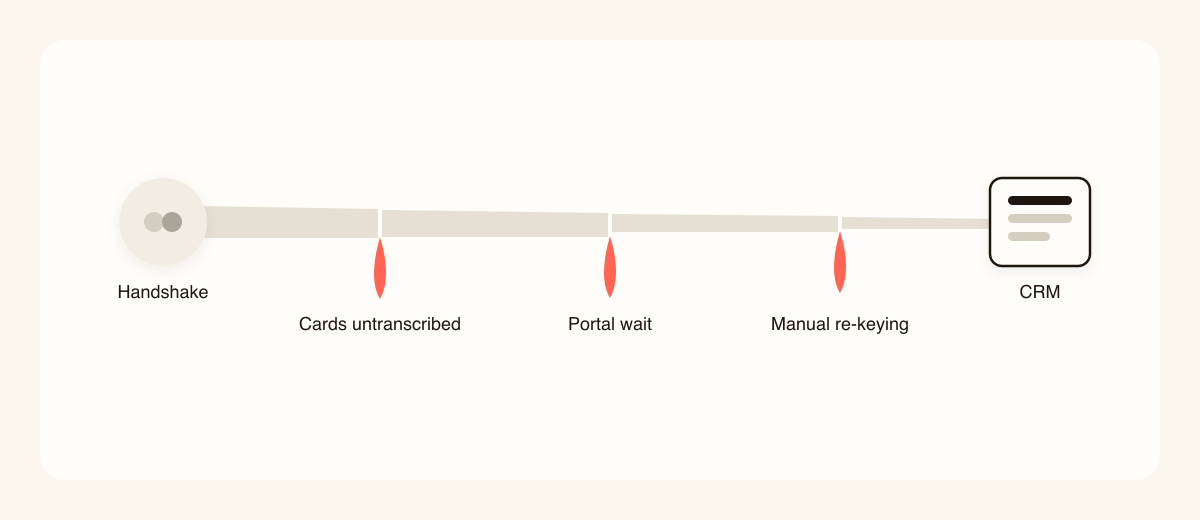
Most of the leads an exhibitor loses are lost after capture, in the gap between the show floor and the CRM: the photo that never gets transcribed, the portal export that waits for a flight home, the routing that assigns nobody. Capture tooling is largely a solved problem. The handoff behind it is where the leak lives.
The first leak is capture that never becomes a record. One marketing events specialist at a water-infrastructure software company described her team's process plainly: "They take a picture and send it to me so I can put it in a spreadsheet."
The second leak is the wait. When leads sit in an organizer's portal until someone exports a CSV, the clock runs while nobody works them. A marketing events lead at a financial data company put a number on it: "By the time we get it to marketing analytics, it's cold, 10 to 15 days post event."
The third leak is manual re-keying. Every hand-typed email address is a chance to lose a lead to a typo, and every row copied between spreadsheets is unowned work that slips when the week gets busy.
Until your tooling changes, the fix that costs nothing is ownership: name one person who exports the portal the same day the show closes.
Up to 70% of leads never make it into the CRM when capture runs on paper cards. That gap is why we built our event lead capture app.
How fast should you follow up on event leads?
Follow up on event leads within 24 to 48 hours of the conversation, and same day for the hot ones. That window is while the conversation is still fresh on both sides: they remember the demo, you remember what they asked. Most teams miss it, and the usual culprit is that the leads haven't arrived yet. Every message here assumes contact details you have a lawful basis to email; the enrichment section above covers that check.
The industry's own numbers are old but blunt: 62% of exhibiting leads were contacted within five days, and only 22% of exhibitors respond within 24 to 48 hours of the show, per EXHIBITOR Magazine's Sales Lead Survey from 2015. We haven't found comparable non-vendor research published since. The famous five-minute rule comes from a different channel; the FAQ below covers what it does and doesn't prove for event leads.
Speed alone doesn't save a generic email. The competitor problem is real; your leads met other vendors at the same show. The expectation problem is just as real: exhibitors like the scan-and-email-later workflow far more than attendees do. Freeman's 2025 commercial trends research (1,022 attendees, 969 exhibitors, margin of error 3.1%) asked both groups to pick the top three things that would most improve their interactions. 49% of exhibitors chose "scanned and emailed afterwards about products and services." Just 23% of attendees picked the same.
Follow-up speed is also downstream of routing. You can't send a Tuesday email about a Thursday conversation you haven't exported yet, which is why the fix for slow follow-up usually sits earlier in the pipeline than the email itself.
For cadences, templates, and what to write, our guide to following up on trade show leads goes deep, including the longer nurture track for leads that are real but not ready to buy this quarter.
Already sitting on a stale batch from the last show? Work it anyway. Order by heat first (who asked for pricing, who talked longest), then by recency, and lead with the conversation you actually had, not an apology for the delay. Then fix the export before the next show.
What tools handle event lead management?
Three categories of tools handle event lead management: lead retrieval rentals from the event organizer, standalone event lead capture platforms that travel with your team, and the event modules inside CRMs and event-management platforms. They differ most in who controls the data and how fast it reaches your CRM.
Blinq's event lead capture is a standalone platform: a rep saves a contact during a live show, the lead files itself under the right event campaign, and it lands in the linked CRM the same day.
The choosing question is volume. A team working a dozen shows a year needs cross-show consistency; a single-show exhibitor may get by with the rental if one named owner handles the same-day export.
Whichever category you pick, the real adoption work is the setup from the pre-event stage: the fields, the routing, the owner. For a ranked look at specific options, see our guide to the best event lead capture software.
How do you measure event lead management?
Measure event lead management by the pipeline each event produced and the speed of the stages in between, not by scan counts. A scan total says the booth was busy. Pipeline per event, capture-to-CRM time, and follow-up rate say whether the busy-ness became business.
The measurement gap gets confessed more often than it gets fixed. The water-infrastructure events specialist quoted earlier told us: "Our ROI last year on events was terrible because nobody tracked anything."
The stakes justify the plumbing: exhibiting takes roughly 41% of exhibitor marketing budgets, the largest single channel, per CEIR's 2026 Marketing Spend Decision Report. Six KPIs (key performance indicators) are worth tracking per show:
All six depend on one piece of plumbing: a campaign record for each show in your CRM, with leads tagged to it and opportunities attributed to it. Without that record, event ROI is a reconstruction. With it, ROI is a report.
FAQs
Does event lead management mean managing event staff?
No. An event lead is a job title, the person who runs an event. Event lead management is about the leads an event produces: the prospects your team captures at the booth, and how they move through qualification, your CRM, follow-up, and measurement. If you're researching the role itself, this piece covers the leads.
What is the 5-minute rule for leads?
The five-minute rule says to contact an inbound lead within five minutes of their inquiry. It comes from Oldroyd's 2007 Lead Response Management study of inbound web-form leads, later written up in HBR in 2011. The original work was vendor sponsored. Treat it as reasoning rather than a measured fact about event leads: response speed compounds, and event leads add a decay those studies never measured, because your competitor met the same person at the same show.
Can you manage event leads without dedicated software?
Yes, at low volume. A spreadsheet, calendar discipline, and one named owner can handle a handful of leads from an occasional event. The cost is manual handling: re-keying contact details, routing by hand, and no per-event attribution. Once you're running multiple shows a year, or multiple reps are capturing, the manual hours and the errors usually cost more than the tooling.
Who owns event lead management, marketing or sales?
Marketing and sales both own it, split by stage. Marketing typically owns the setup, the capture standards, and the measurement; sales owns qualification during conversations and the follow-up. The failure mode is the handoff nobody owns: the export and the routing. That's why the pre-event stage assigns an owner by name before the show starts.
See where your event leads go next
If leads are stalling between the booth and your CRM, that gap is the fixable part. See how Blinq's trade show lead capture app moves each capture into your connected CRM the same day, filed under the show that produced it.