

.avif)

Pre-event outreach is the work of finding out who's attending a trade show, getting contact details for the people who matter, and booking time with them before the doors open. It doesn't replace what happens at the booth. Good outreach shapes who walks up to it, so the floor time you've already paid for delivers more.
I work at Blinq, where we develop event lead capture software. It shows up below where it's relevant, alongside other tools.
Key Takeaways (TL;DR)
- Pre-event outreach amplifies your booth; it never replaces booth capture. Attendees prefer pre-planned exhibitor meetings (Freeman, 2024), but most still find exhibitors through the organizer's floor map and listings. Outreach is for the accounts you flew there to meet.
- Start around eight weeks out. Building, ranking and enriching a list takes longer than writing the emails, and show-week calendars fill up fast.
- Consider building the attendee list yourself. Major organizers typically don’t sell attendee data, but it is possible to combine the public exhibitor list, their own CRM and LinkedIn, or purchase from data partners.
- Rank the list into tiers before anyone sends anything. Only a slice of it deserves a meeting request; another slice just needs your reps to recognize the name at the booth, and that second group is what makes booth capture smarter.
- Contact details are where most plans stall. A ranked list without work emails can't be actioned, so schedule enrichment like any other step.
- Measure the split between pre-booked and walk-up pipeline. Scan counts tell you how many people came, not whether they were the right ones. The pre-booked share shows that, and a healthy show produces pipeline from both.
What is pre-event outreach, and how does it fit with your booth plan?
Pre-event outreach is targeted, one-to-one contact with named people who'll be at an event, made before it starts, with the aim of booking a conversation. It's narrower than pre-event marketing, which broadcasts your presence to a whole audience, and it works alongside booth capture rather than replacing it.
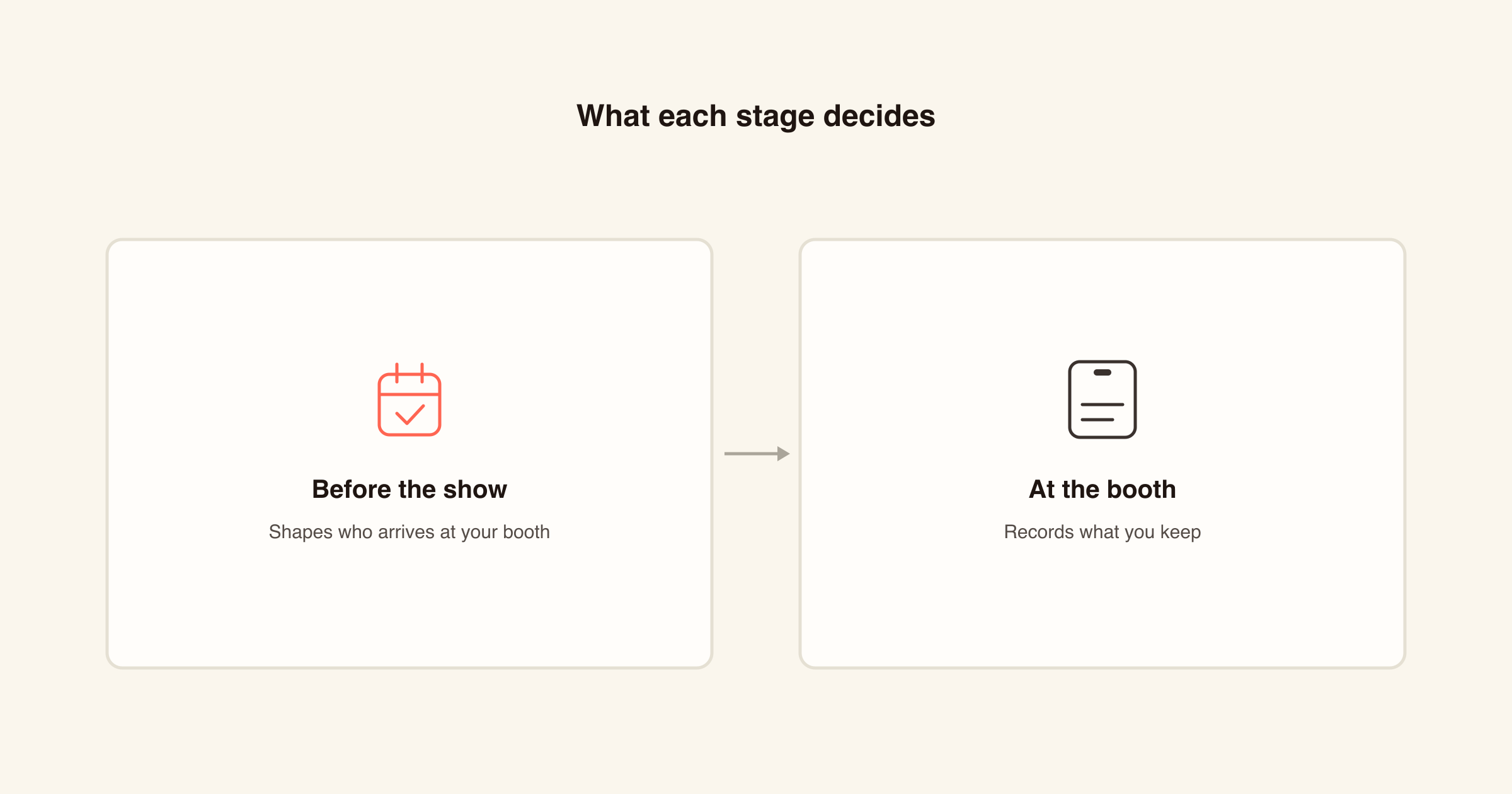
| Stage | What it does | What good looks like | How you measure it |
|---|---|---|---|
| Before the show | Shapes who arrives at your booth | A ranked list of named accounts with contact details and booked slots | Booked-meeting rate against target accounts |
| At the booth | Records what you keep from every conversation | Every visitor captured with context, invited or not | Leads captured, qualification fields completed |
| After the show | Converts what you captured | Follow-up sent while the conversation is fresh, attributed to the event | Meetings held, pipeline attributed to the event |
Does pre-event outreach improve booth results?
Yes, pre-event outreach improves booth results by bringing more of the right people to your booth: booked meetings put priority accounts on the schedule, and even the people who don't book are more likely to stop by a name they recognize. Attendees want it too: in Freeman's 2024 survey of 2,002 event attendees, pre-planned exhibitor meetings ranked above unplanned ones as a way to interact with exhibitors, behind only hands-on demos and interactive experiences.
Email isn't how most attendees plan, though. When Freeman asked 1,022 attendees in 2025 what helps them decide which exhibitors to visit, the floor map came first at 61% and the exhibitor listing second at 57%, with email from exhibitors reaching about one in five. Most of that planning happens inside the organizer's tools, so aim your outreach at your highest-value accounts, the ones you can't afford to leave to the floor map.
Sissy Qin, on our marketing team, has run the play as an attendee: “I went to a Blackbird event a few years ago where you could see the attendee list and reach out. I sent a few messages, people replied, and we set up meetings. It set the scene for what the chat would be about, and it made them more likely to want to talk. They knew my intentions and who I was.”
That recognition shortens the conversation at the booth. Someone who's already read a message from you skips the two minutes a stranger spends working out whether you're worth talking to.
I've been on the receiving end myself. I once got a pre-event email about an event I wasn't sure I'd make it to. It still worked as a cold email: it put the company on my radar, and we ended up becoming a customer.
If you need a number for the business case, exhibiting already takes 41% of the average B2B exhibitor's marketing budget, and outreach is a small addition that works a committed cost harder.
How far ahead should you start pre-event outreach?
Start pre-event outreach around eight weeks before day one. That gives you time to build, rank and enrich a list while show-week calendars are still open. First contact lands around six weeks out, booking conversations happen at three, and confirmations go out in the final week. Compress that and you're competing with everyone else's last-minute invitations.
The schedule below is how we sequence it before our own shows (the logistics side of show prep lives in our trade show preparation checklist). Treat it as a starting point and adjust it to your event: for a regional show or a few-hundred-person conference, four to six weeks is usually plenty, because the list is shorter and calendars are less contested.
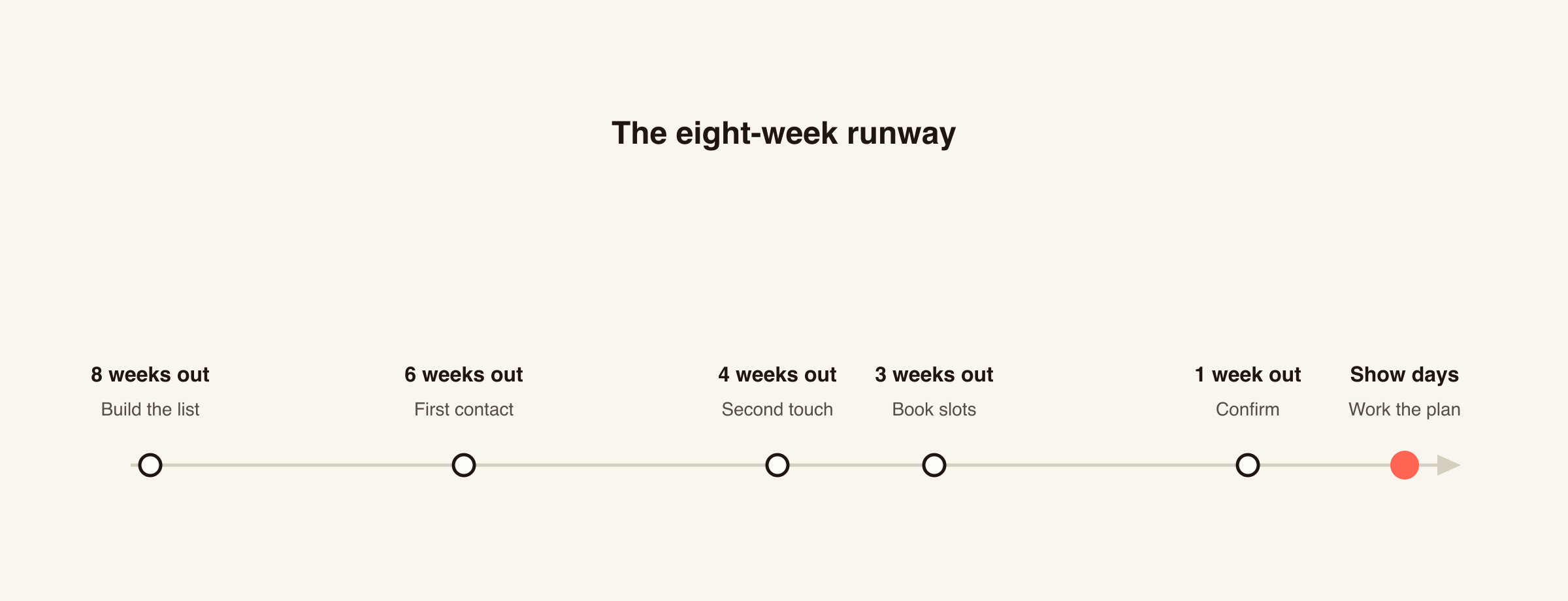
| Timing | What you’re doing | Why then |
|---|---|---|
| 8 weeks out | Build the list, rank it, enrich the top of it | Show-week calendars are still open |
| 6 weeks out | First contact with your priority accounts | Early enough to be among the first invitations they get |
| 4 weeks out | Second touch, widen to the next group | Catches the people who missed the first message |
| 3 weeks out | Book slots | Travel is usually confirmed by this point |
| 1 week out | Confirm, send your booth number and a calendar hold | Cuts no-shows |
| Show days | Work the booked schedule, capture everyone else | Booked meetings give the day fixed points to build around |
Expect to lose some booked slots anyway. People miss flights and get pulled into customer meetings, so keep the booth staffed for walk-ups throughout.
How do you find out who's attending a trade show?
Exhibitor lists are usually published on the event site; attendee lists usually aren't. Whether you can see who's attending depends on the show: smaller conferences and association events often publish an attendee list, surface it in the event app, or share it as a sponsor benefit, while the biggest US organizers put it in writing that they never release attendee data.
The National Retail Federation “does not and has NEVER sold or rented attendee information”, and the Consumer Technology Association states that “CTA does not sell or otherwise make publicly available the CES attendee list”. One warning while you're looking: the emails offering to sell you the CES or NRF list are a known scam, and organizers publish standing warnings about them.
For the bigger shows, exhibitors build their own view instead. In practice that means pulling the exhibitor list from the event site (exhibitors send attendees too, and they're often the easiest meetings to book), searching LinkedIn for people posting about the show, checking the event app once registration opens, and cross-referencing your CRM for customers and open deals in the host city. A few focused hours usually produce more names than your reps can work.
Plenty of teams still piece this workflow together with generic tools. Dedicated event-intelligence platforms such as Vendelux and Lensmor can help teams build this layer. As an example, Lensmor combines event, exhibitor and attendee data from event-organizer relationships, data partners and public signals across its coverage of 160,000+ trade shows. It helps revenue teams discover relevant events, identify high-fit accounts and decision-makers, surface relevant attendee signals where available, and build an outreach list before the show. Blinq complements that work on the floor by capturing, enriching and syncing the conversations reps actually have.
How do you decide which accounts to prioritize before an event?
Rank your attendee list into three tiers before anyone sends anything; a long list of unranked names gives your reps nothing to work from. Tier one is accounts worth booking a meeting with in advance. Tier two is accounts your reps should recognize if they visit the booth. Tier three is everyone else; they get captured at the booth like any other visitor. The tiers work at any size of event: at a 300-person conference, tier one might be 25 accounts handled by a single rep.
Three things decide the tier: how well the account fits your ICP, how relevant this particular event is to them, and whether anyone at your company already knows them. An existing relationship tends to beat a better-fitting stranger, because a warm intro gets replies that a cold email won't.
Most teams skip tier two, but it's the piece that makes booth capture smarter. A rep who knows a named account is on the floor can pick up a conversation already in progress somewhere else in the business.
How do you turn an attendee list into contacts you can reach?
To reach the people on your list you need work emails and direct numbers, and the list you've built rarely comes with them. Most pre-event plans stall right here: the target list exists and nobody can act on it before travel. The fix is bulk enrichment: tools that take a list of names and companies and return the contact details attached to them.
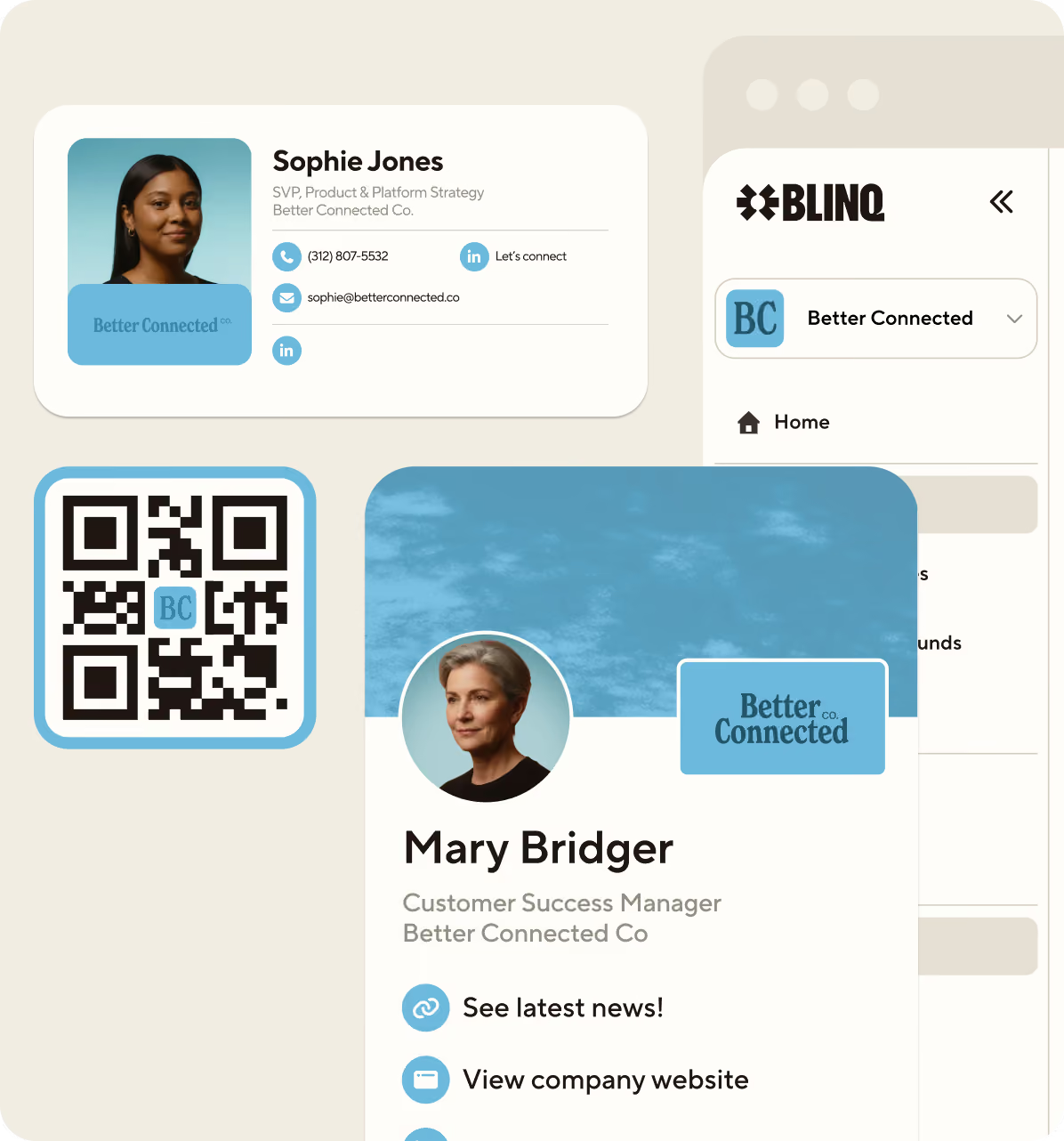
This is the part of the job our own product does. Blinq runs bulk lead enrichment on an uploaded attendee list and returns work emails and direct numbers where our data providers have them. Contacts you enrich before the show can sit alongside the leads your reps capture at the booth, so the pre-event list and the on-floor scans end up in one place.
No budget for tooling? Do tier one by hand. For 20 or 30 accounts, LinkedIn and the company website get you most of the way.
What should you send attendees before the show?
Before a show, send attendees a short, specific message saying who you are, why you're contacting this person, and what you're proposing. For an account you want a booked meeting with, that means a meeting request with a suggested time and your booth number. For the rest of the list it's a lighter note letting them know you'll be there. Keep it to a few sentences with one clear ask.
Something like this, for a tier-one account where a rep has no existing relationship:
Subject: 20 minutes at SaaStr, Tuesday or Wednesday?
Hi [name], I saw [company] is heading to SaaStr. We're at booth 412, and we've been working with a few [industry] teams on [specific problem], which I think overlaps with what you're building.
Worth 20 minutes on Tuesday or Wednesday morning? Happy to work around your schedule.
[Name], [company]. [Postal address]. [Unsubscribe link.]
The tier-two note can be two lines:
Hi [name], I saw you're heading to SaaStr as well. We're at booth 412. If you're walking the floor on Tuesday, stop by and I'll show you what we've been building for [industry] teams.
We keep it to two channels. Email goes first because it can carry a calendar link, then LinkedIn a few days later for anyone who didn't reply, referencing the email so it reads as a follow-up rather than a second cold open. If the event runs an app or community with an attendee directory, use that as well; at smaller conferences it's often the highest-reply channel, because everyone in it chose to be visible. And before anything goes out, check your email signature: it's often the first thing a curious recipient clicks, so make sure it links to who you are.
Expect most messages to go unanswered. That's normal for cold outreach, and it's why the ranking and the existing relationships matter more than clever wording. Giving people a reason to turn up beyond the conversation helps: a demo slot, a reserved seat at a session you're running, or something worth collecting at the booth.
How do you put your target list to work at the booth?
Configure your trade show lead capture tool before you travel. A target list left in a spreadsheet never gets used on the show floor, so set up your qualification questions in the capture tool and brief your reps on the priority accounts before you leave.
With Blinq's trade show lead capture app, you set each event up as its own campaign with its own capture form, so every rep asks the same qualification questions the same way. Add a question like “Is this a target account?” and reps can flag a priority visitor the moment they meet them, and every lead they capture syncs straight to your CRM so you can follow up fast. Still choosing a tool? Here's our full overview of the best trade show lead capture apps.
Knowing who's coming also tells you who to staff the booth with. In Freeman's 2025 research, 58% of attendees said speaking with a subject-matter expert improves a booth visit. If you know which accounts are coming, you know which experts to bring.
How do you measure whether pre-event outreach worked?
Measure pre-event outreach with five numbers: booked-meeting rate, show-up rate, meeting-to-opportunity rate, cost per booked meeting, and the split of pipeline between pre-booked meetings and walk-up capture. Treat them as a starting point, and don't chase a 100% pre-booked split.
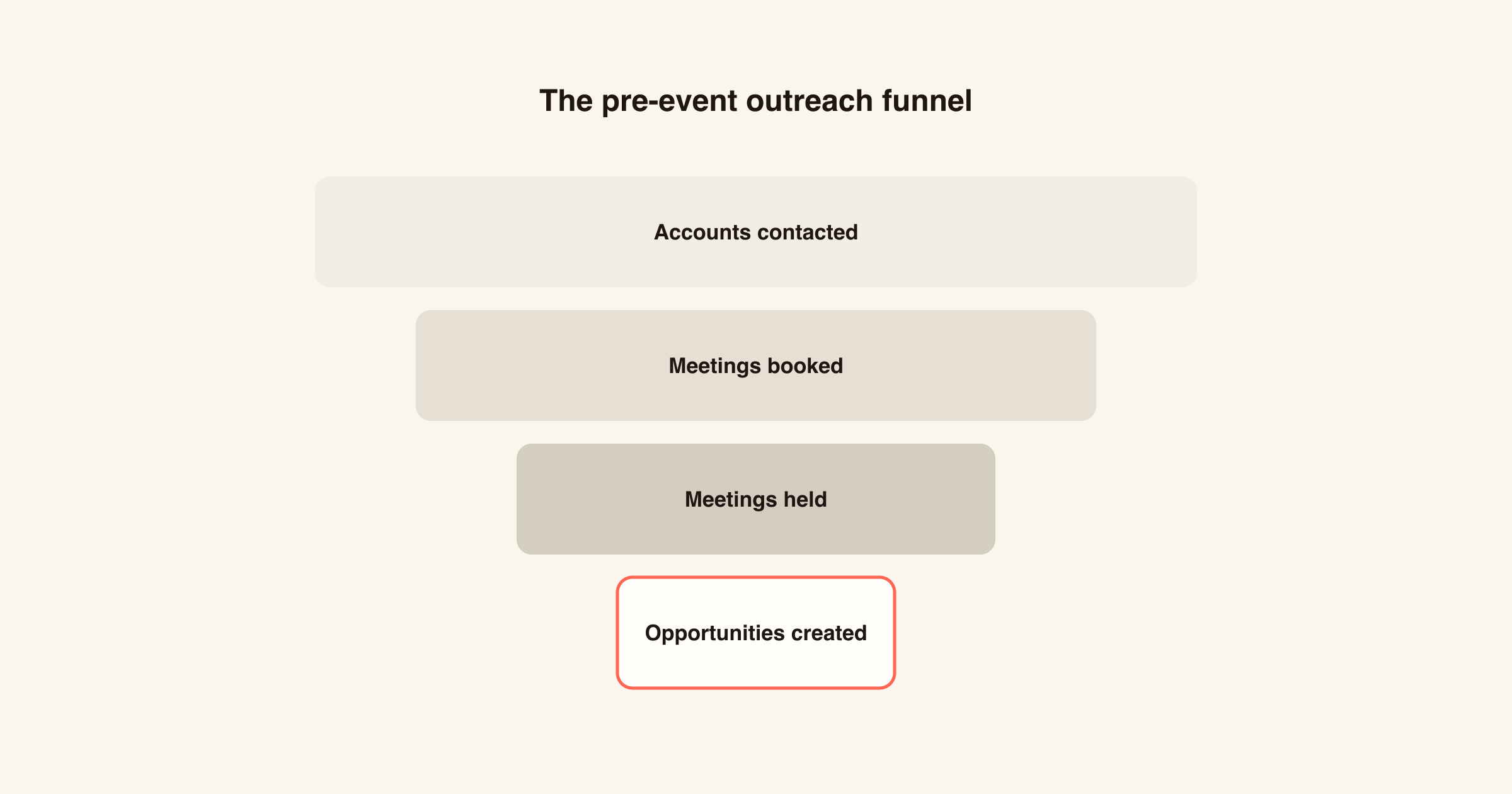
| Metric | What it tells you | How to calculate it |
|---|---|---|
| Booked-meeting rate | Whether the outreach is landing | Meetings booked ÷ tier-one accounts contacted |
| Show-up rate | Whether your confirmations are working | Meetings held ÷ meetings booked |
| Meeting-to-opportunity rate | Whether you targeted the right accounts | Opportunities created ÷ meetings held |
| Pre-booked vs walk-up pipeline | What the outreach contributed against what it cost | Event pipeline split by lead source in your CRM |
| Cost per booked meeting | Whether to scale outreach at the next show | Outreach cost ÷ meetings booked |
Set the event up in your CRM before you travel, so every lead arrives already attributed. The deeper attribution mechanics can wait until after the show; our guide to measuring event ROI goes into them.
A trade show meeting is often one touch in a buying process that started months earlier, so don't hand the whole deal to the event; track the split and the trend instead.
FAQs
Who should own pre-event outreach, sales or marketing?
Pre-event outreach works best with marketing owning the list and the sequencing, and sales owning the conversations. Marketing has the event data, the enrichment tooling and the sending infrastructure. Reps have the existing relationships that lift reply rates. Hand the whole job to sales and the list never gets built; hand it all to marketing and it becomes a list nobody works.
How much does pre-event outreach cost?
Pre-event outreach mostly costs time rather than new software. The real line items are the hours to build and rank the target list, an enrichment tool to find contact details, and whatever your team already uses for email and LinkedIn. For most exhibitors it adds little on top of the event lead capture software and booth investment that's already committed.
Does pre-event outreach work for small events?
Yes, pre-event outreach often works better at small events than big ones. The attendee list is shorter, it's more likely to be visible in the event app or community, and fewer exhibitors are competing for the same calendars. Four to six weeks of lead time is usually enough. Organizer rules vary more at smaller shows, so read your exhibitor agreement before you send anything.
Is it legal to email trade show attendees before an event?
In the US, yes. CAN-SPAM sets no consent requirement and, in the FTC's words, “makes no exception for business-to-business email”: you need accurate headers, a clear indication that the message is an ad, a valid postal address, and an opt-out honored within 10 business days. Your exhibitor contract is usually the tighter limit, and rules differ abroad, since Canada and most EU countries require consent. Check both before you send.
How many meetings should you book before a trade show?
Book as many pre-show meetings as your booth can serve. In our experience, two reps across a three-day show can hold a handful of scheduled conversations each day and still serve walk-up traffic, though the right number depends on booth size, staffing and how long your conversations run. Booking every slot leaves no room for the visitor you didn't expect, who is often the reason the show pays for itself.
Is pre-event outreach worth it for a first-time exhibitor?
Pre-event outreach matters more for a first-time exhibitor than an established one, because nobody is looking for your booth yet. A recognized brand collects walk-up traffic on name alone. If you're exhibiting for the first time, pre-booked meetings are what bring people to your booth, and the badge scans your reps collect become the list you work afterward.
How do you personalize pre-event outreach without spending weeks on it?
Personalize the reason you're contacting someone rather than the wording. One accurate sentence about why this company and this event go together beats a paragraph of flattery, and you can reuse it across a segment. Save one-to-one writing for the accounts you want pre-booked meetings with, and send everyone else a segment-level message that's still specific about the event.
What if pre-event outreach gets no replies, or you run out of time for it?
If pre-event outreach gets no replies or never happens, fall back on the booth; it's still the main engine. Low reply rates are normal, and even unanswered messages buy recognition. Once the window has closed, make the booth the plan: capture every conversation with context, qualify on the spot, and start your follow-up the day the show ends. A lead capture app like Blinq syncs those leads to your CRM while the conversations are still fresh.
Blinq turns the conversations you have at the booth into contacts with context, enriched and synced to your CRM before you leave the show. Book a demo to see how it fits your event program.