



.avif)


Most NFC business card comparisons list specs from a product page. We’ve done the research properly across all six providers on this list, from setting each card up and testing each platform, to modeling each one’s full first-year cost.
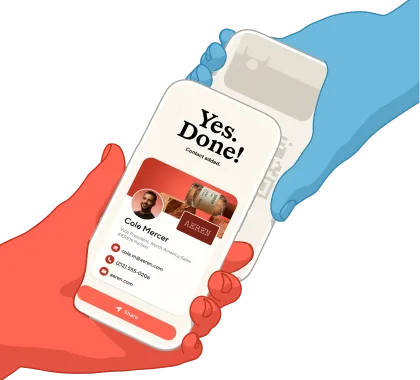
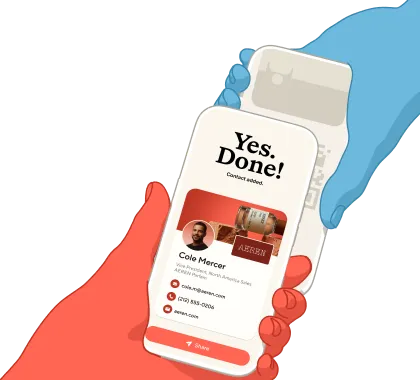
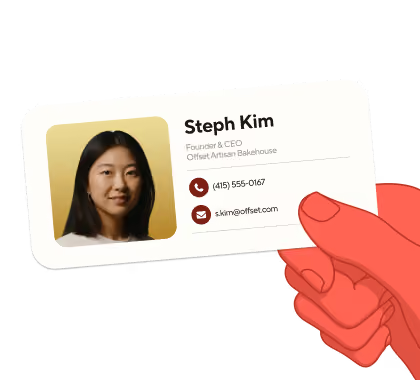
An NFC business card shares your contact details with a phone tap. No app is required for the person receiving it, and because the underlying card is digital, there is no reprinting when your information changes. The card itself costs $15-80, but the bigger cost is often the software behind it: a $20 card with a $7/month platform subscription costs $104 in year one, while a $35 card on a free platform costs $35 total.
We scored six of the best NFC business cards on six criteria and ranked them below. Each product section includes a pricing breakdown so you can compare the real first-year cost, not just the price on the box.
Key Takeaways (TL;DR)
- The cost of an NFC business card goes well beyond the card itself. Some providers charge a monthly subscription for features like CRM sync and analytics, and total first-year costs vary from under $35 to well over $100 depending on the platform tier you need.
- Blinq ranked as the best NFC card with a score of 28/30, thanks to a one-time purchase (from $19.99), the most generous free tier in this roundup (contact sharing, digital profiles, QR backup, and Apple Wallet at no recurring cost), and form factors that go beyond the card (wristband, keychain, phone sticker). It holds a 4.9 average across 200,000+ reviews on the App Store, Google Play, G2, Capterra, and Trustpilot.
- The platforms behind these cards range from basic contact sharing to full CRM sync with automated follow-up sequences. Matching the platform to your workflow might matter more than the card material or design.
- Every card on this list works with both iPhone and Android and includes a QR code backup for devices without NFC.
- The NTAG-family chips used in most NFC business cards are rated for 100,000 write cycles and 10 years of data retention, per the NXP NTAG213/215/216 specification.
The 6 best NFC business cards at a glance
Here’s how the six providers compare. The card price alone doesn’t tell you much, so the table includes the ongoing platform cost for each one. Individual scorecards in each product section break down how we arrived at each score
| Provider | Score | Card price | Platform cost | Materials | Form factors | QR backup |
|---|---|---|---|---|---|---|
| Blinq | 28/30 | From $19.99 | Free / from $4.99/mo | PVC, metal, wood | Wristband, keychain, sticker | Yes |
| Mobilo | 24/30 | From $19.99 | Free / $4/mo | PVC, wood, metal | Key fob, smart button | Yes |
| Wave | 21/30 | From $23 | Free / $7/mo | Bamboo, metal | Bracelet, phone tap | Yes |
| V1CE | 20/30 | From ~$78 | Free / ~$65/mo | PVC, metal, bamboo, gold | Sticker, standalone tap | Yes |
| Dot | 19/30 | From $53 | Free / from $8/member/mo | Plastic | Sticker, thin insert, wristband | Yes |
| Popl | 18/30 | ~$19.99 | Not listed on popl.co | PVC, metal | Sticker, phone card, keychain, wristband | Yes |
How we evaluated and scored each provider
We tested all six cards and scored them on six criteria. Each criterion uses a 1-to-5 integer scale, with 5 as the best. Total score is out of 30, with equal weight across all six.
Pricing (1-5): Measures how much of the platform you can use without a recurring payment. A 5 means every feature is included with a one-time card purchase. A 1 means a subscription is required for the card and platform to function. Products that lock specific features (CRM sync, analytics, branding) behind a monthly fee land in between, scored by how much is gated and what it costs. To put that in perspective, a $20 card with a $7/month subscription costs $104 in year one. A $35 card with a free platform costs $35.
Card pricing and materials (1-5): Considers the lowest entry price, the range of price points, and the number of distinct materials available (PVC, metal, wood, bamboo). A wider range with a lower floor scores higher.
Form factors (1-5): Counts the types of NFC products beyond a standard card. Wristbands, keychains, phone stickers, and standalone taps all count. A cards-only lineup maxes out at 2.
Platform features and CRM (1-5): Evaluates the software behind the card at its most capable tier: contact sharing, CRM sync or a built-in CRM, lead capture, team management, analytics, and automated follow-up. What it costs to unlock that tier is scored separately under Pricing, so a heavily paywalled platform can score well here and still lose ground there.
QR code backup (1-5): Checks whether the card includes a printed QR code that works when the recipient’s phone doesn’t support NFC or when you need to share at a distance. A 5 means QR on every product in the line.
Setup ease and device compatibility (1-5): Measures the steps between buying a card and sharing your first contact. Fewer steps, broader device support, and no mandatory subscription activation score higher.
All scores are our assessment, based on published pricing and features verified on each vendor’s website in September 2026. We update scores when vendors change their pricing or feature availability.
1. Blinq
Blinq sells NFC business cards as a one-time purchase with the most generous free tier in this roundup. It scored 28/30, the highest in this roundup, and holds a 4.9 average across 200,000+ reviews on the App Store, Google Play, G2, Capterra, and Trustpilot. For anyone who wants a card that covers contact sharing, lead capture, and CRM sync without layering on multiple subscriptions, the combination of price, platform, and form factor range is the strongest here.
| Criterion | Score |
|---|---|
| Pricing | 4/5 |
| Card pricing and materials | 5/5 |
| Form factors | 5/5 |
| Platform features and CRM | 4/5 |
| QR code backup | 5/5 |
| Setup ease and compatibility | 5/5 |
| Total | 28/30 |
Pricing and ownership
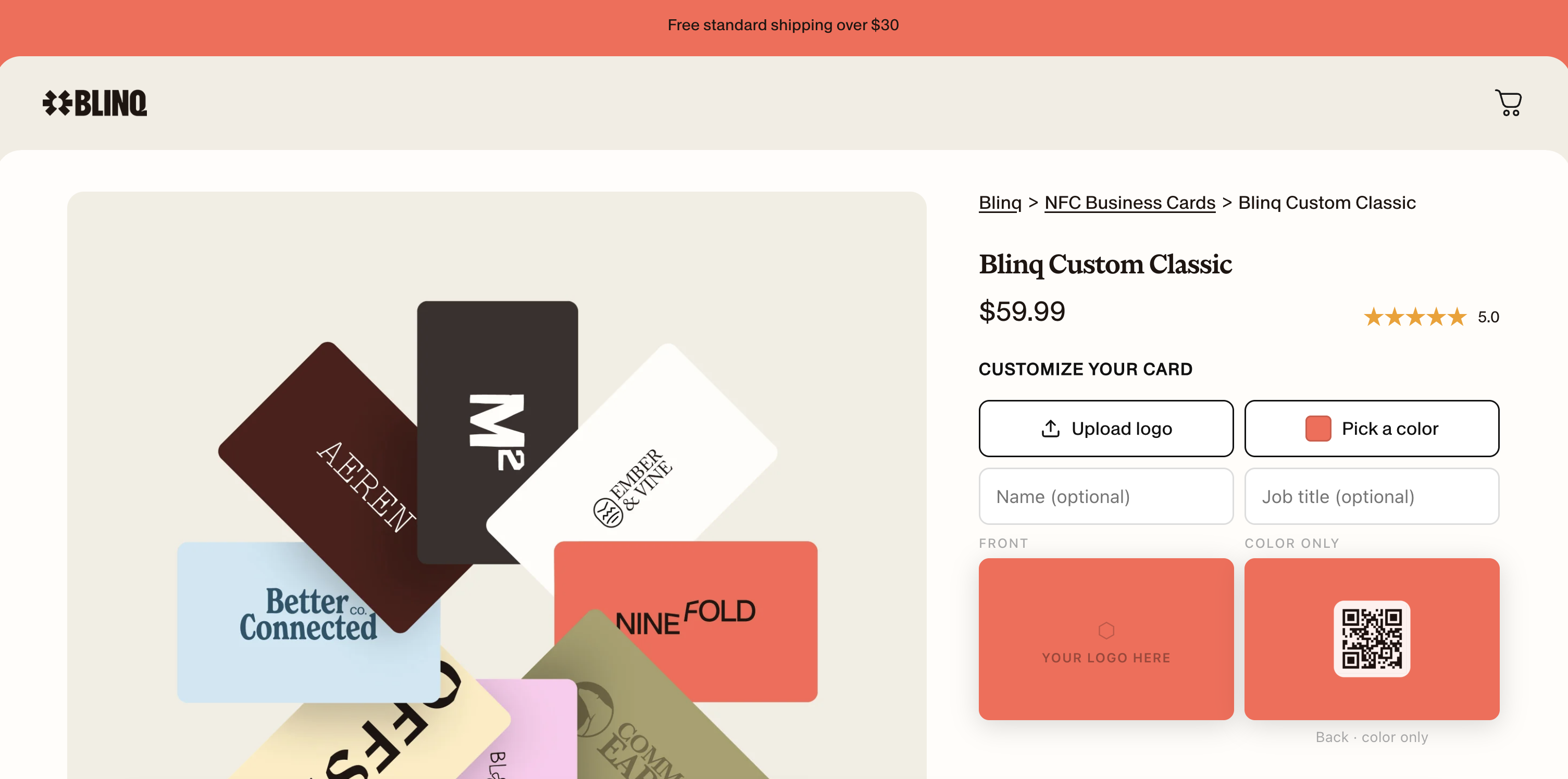
Blinq cards are a one-time purchase with no subscription required. Each card ships with two free digital profiles, unlimited card sharing and contact creation, QR backup, and Apple Wallet support at no recurring cost. CRM integrations, lead capture with enrichment, team management with admin controls, and advanced analytics are available on Blinq’s Business plan (from $4.99 per user per month, billed annually; $6.99 month to month).
The Essential line starts at $19.99 for a phone sticker and runs to $49.99 for a metal card. The Custom line runs $59.99 (Classic), $69.99 (Eco Wood), and $79.99 (Metal). Classic is UV printed in full color; Eco Wood and Metal are laser engraved with your logo and details. Bulk discounts apply automatically at volume, and free shipping kicks in over $30.
Year-one cost for a single metal card on the free tier: $49.99. Year-two cost: $0.
Cards and form factors
Blinq sells six NFC product types: Classic PVC ($24.99), Metal ($49.99), Eco Wood ($29.99), Wristband ($29.99), Phone Sticker ($19.99), and Keychain ($24.99). The Custom line adds branded versions of the Classic, Eco, and Metal cards.
Every product includes a QR code, NFC tap, and water resistance. Non-card accessories start at $19.99. Custom cards ($59.99 to $79.99) put your logo and details on the front, UV printed in full color on Classic and laser engraved on Eco Wood and Metal.
You can set up your card from scratch in about two minutes.
Platform and team tools
The free tier includes contact exchange, two digital profiles, a QR code that works when NFC doesn’t, and Apple Wallet support. Blinq’s Business plan (from $4.99/user/month, billed annually) adds lead capture, CRM sync (direct integrations plus 6,000+ Zapier integrations), team management with admin controls, and analytics for profile views and contact saves.
Automated email follow-up sequences and per-scan analytics are not part of the current feature set. V1CE offers automated follow-up through its subscription.
2. Mobilo
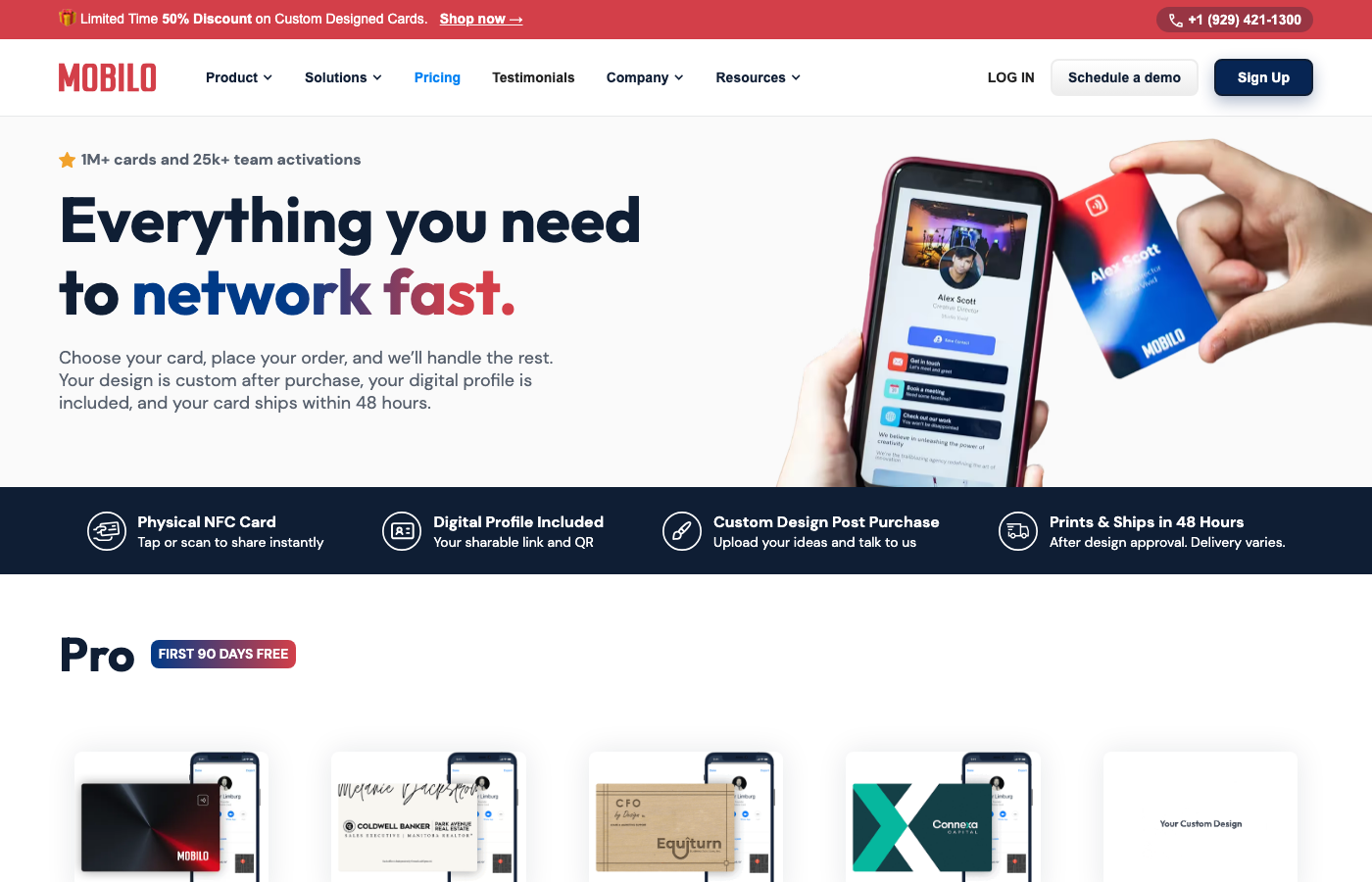
Mobilo is a US-based NFC card company focused on sales teams. It scored 24/30, with strong marks on platform and setup but a limited hardware lineup. Every card ships with a 90-day Pro trial, giving you CRM sync, branding, and analytics from day one. After the trial, those features require a paid plan. Its App Store rating is 4.6 from about 700 ratings, with mixed sentiment on Trustpilot (3.6 from 300+ reviews).
| Criterion | Score |
|---|---|
| Pricing | 4/5 |
| Card pricing and materials | 4/5 |
| Form factors | 3/5 |
| Platform features and CRM | 4/5 |
| QR code backup | 4/5 |
| Setup ease and compatibility | 5/5 |
| Total | 24/30 |
Pricing and ownership
Mobilo cards are a one-time purchase. The lineup runs from Branded PVC ($19.99) through Custom Classic ($39), Custom Wood ($59), to Custom Metal ($139). Every card ships with 90 days of Pro included, covering CRM sync via Zapier, custom branding, and analytics.
After the trial, the platform reverts to a free tier with basic sharing. Teams runs $4/month per member and adds admin controls, lead routing, and team analytics. Year-one cost for a standard card on Teams after the trial: $55.99 ($19.99 card + $36 subscription for the remaining nine months).
Cards and form factors
Mobilo sells four card types spanning PVC, wood, and metal, plus a Key Fob and a Smart Button for phone-back NFC sharing. The Custom Metal comes in grey, black, and gold finishes with laser engraving on the back.
If form factor variety matters to you, Mobilo’s range is narrower than most. If you want a well-built card with a strong trial period included, it holds up.
Platform and team tools
The Pro tier includes CRM sync through Zapier (Salesforce, HubSpot, and other CRMs are connected through that layer), lead capture forms, and contact exchange. The Teams tier adds centralized management, role-based access, and team-wide analytics.
On the free tier after the 90-day trial expires, you keep basic contact sharing but lose CRM sync, branding, and analytics. That makes the ongoing cost a real factor if your team depends on CRM integration.
3. Wave Connect
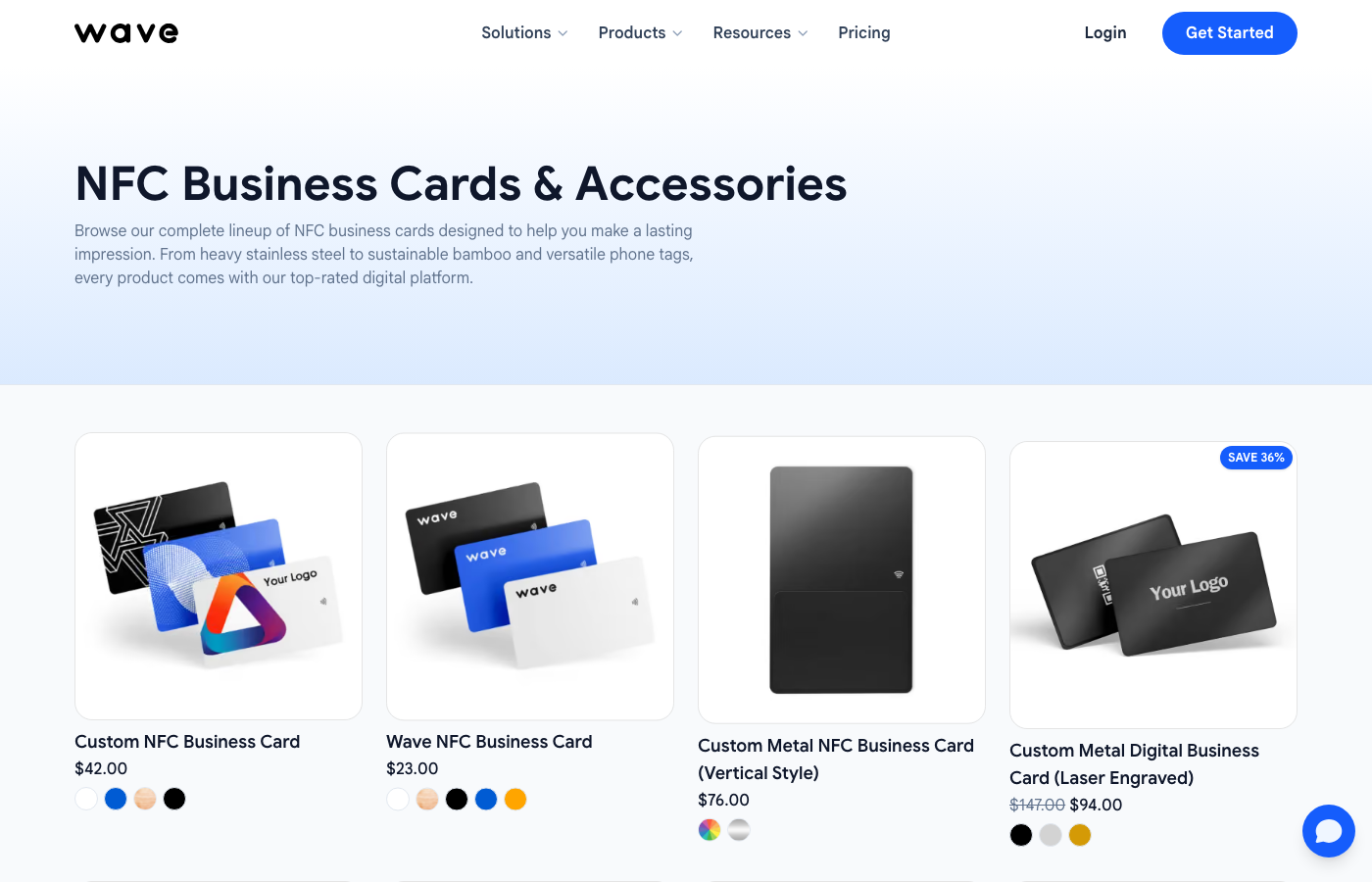
Wave Connect stands out for one thing: lead capture at no cost. Most competitors charge a monthly fee for that feature or lock it behind a trial. Wave scored 21/30. Cards are a one-time purchase and the platform lets you collect contacts without a subscription, though CRM sync and team features need a $7/month Pro plan. Wave holds a 4.8 on the App Store from about 1,500 ratings and about 900 reviews on G2.
| Criterion | Score |
|---|---|
| Pricing | 4/5 |
| Card pricing and materials | 3/5 |
| Form factors | 3/5 |
| Platform features and CRM | 4/5 |
| QR code backup | 3/5 |
| Setup ease and compatibility | 4/5 |
| Total | 21/30 |
Pricing and ownership
Wave cards are one-time purchases: the standard bamboo card starts at $23, the Metal card at $53, and the Custom Metal Laser Engraved at $94 (a sale price at the time of writing, down from $147). The platform is free for basic contact sharing and analytics, and lead capture costs nothing.
Pro ($7/month) adds CRM integration and custom branding. Teams ($5/user/month) adds centralized management and team reporting. Year-one cost for a bamboo card on Pro: $107 ($23 card + $84 subscription).
The split model lets you start for free with a digital profile, buy a card when you’re ready, and add paid features as your needs grow.
Cards and form factors
Wave sells bamboo and metal NFC cards, plus a bracelet and a phone tap. Bamboo is the standard card (only one other vendor on this list offers the material), and metal rounds out the premium end.
Platform and team tools
Wave includes lead capture and analytics on its free tier. Most competitors paywall these features or limit them to a trial period. You can collect contact details from anyone who taps your card or scans your QR code without paying a subscription.
Pro and Teams add CRM sync (direct integrations with Salesforce, HubSpot, and others) and admin controls. For a team that wants lead capture without a monthly commitment, Wave’s no-cost plan is hard to beat.
4. V1CE
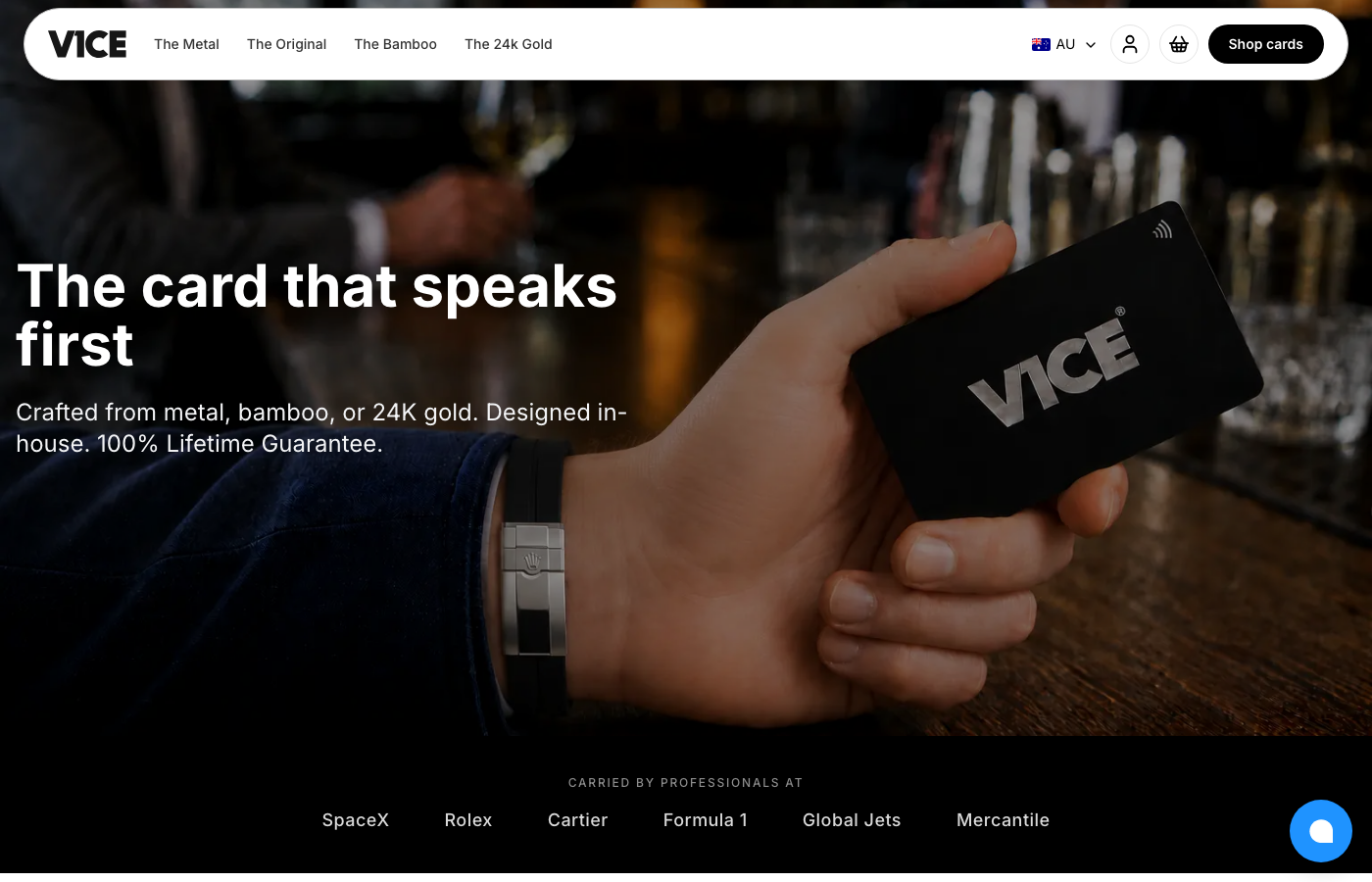
V1CE is a UK-based NFC card company that sells cards as a one-time purchase with a free basic platform included. The platform scored 5/5 on features: its Client Capture OS subscription (~$65/month) bundles a built-in CRM, AI contact enrichment, automated follow-up, a booking calendar, agreements, and payments. V1CE scored 20/30 overall and carries about 1,000 reviews on Trustpilot (4.4).
| Criterion | Score |
|---|---|
| Pricing | 2/5 |
| Card pricing and materials | 2/5 |
| Form factors | 4/5 |
| Platform features and CRM | 5/5 |
| QR code backup | 4/5 |
| Setup ease and compatibility | 3/5 |
| Total | 20/30 |
Pricing and ownership
V1CE cards are a one-time purchase that includes basic profile and sharing features in the V1CE app. Cards start from about $78 for The Original (PVC), with Metal, Bamboo, and 24K Gold options at higher price points.
Advanced features sit behind V1CE’s Client Capture OS subscription (GBP 49.99/month, about $65), which V1CE pitches as its main offer: it bundles the CRM, follow-up automation, booking, and payments, includes a card with lifetime replacements, and comes with a 30-day free trial (you keep the card if you cancel).
Year-one cost for a PVC card on the free platform: approximately $78. Compare that to a $24.99 PVC card on Blinq or a $55.99 first-year cost on Mobilo’s Teams plan.
V1CE is a UK-based company with workshops in the UK, US, and UAE. All V1CE prices in this article are converted from British pounds at an approximate exchange rate.
Cards and form factors
V1CE offers four card materials (PVC, metal, bamboo, 24K gold) plus accessories including a Tap Table Tent, Tap Phone Cards, and a standalone NFC tap device. The standalone tap sits on a desk or counter and lets visitors tap without handing over a card.
24K gold is a material you won’t find with any other vendor on this list. Non-card accessories are limited compared to the range from other vendors, but the materials themselves include the highest-end option here.
Platform and team tools
V1CE’s platform is the most feature-complete in this roundup. It includes a built-in networking CRM (pitched as a replacement for HubSpot or Pipedrive rather than a sync), AI contact enrichment, automated follow-up email sequences triggered by a card tap, a booking calendar, agreement signing, and payment processing.
The free platform covers basic contact sharing and profile creation. Everything else requires the Client Capture OS subscription. If automated follow-up and an all-in-one client workflow drive your sales process, V1CE offers more platform capability than any alternative here, though you’ll need to budget for the monthly cost.
5. Dot
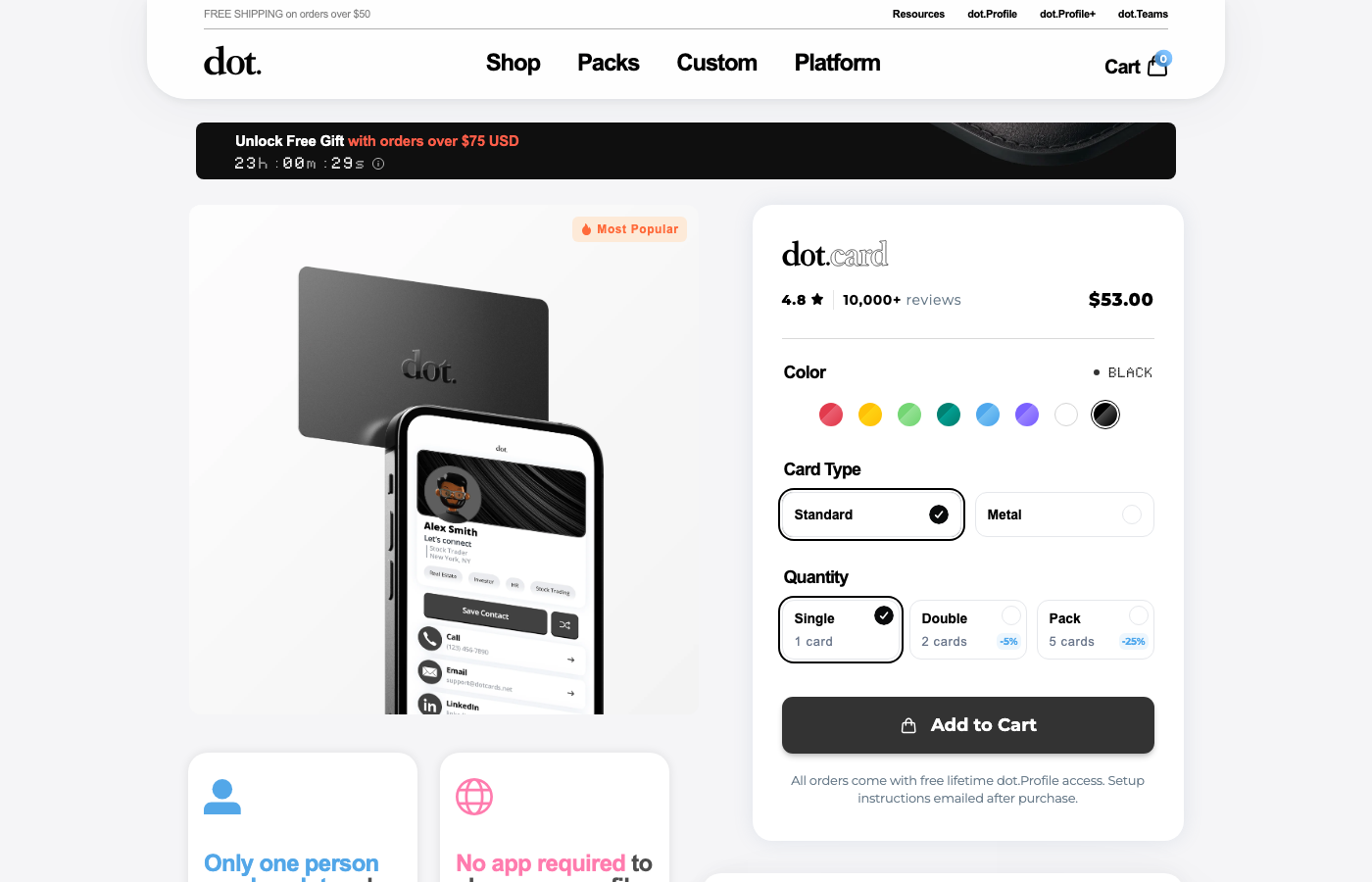
Dot is a design-focused NFC card company with the widest range of colorways in this roundup. It scored 19/30. The cards look premium, but analytics, contact export, and branding all sit behind a paid plan on top of the card price. Dot has about 1,000 reviews on Trustpilot (4.2), with minimal presence on other review platforms.
| Criterion | Score |
|---|---|
| Pricing | 3/5 |
| Card pricing and materials | 2/5 |
| Form factors | 4/5 |
| Platform features and CRM | 3/5 |
| QR code backup | 4/5 |
| Setup ease and compatibility | 3/5 |
| Total | 19/30 |
Pricing and ownership
Dot cards start at $53 for the standard card. The Dot Profile (the platform) is free for basic sharing and contact exchange. An individual Plus plan runs $15/month ($12/month billed annually) for analytics and export. Team plans, billed annually, run $8/member/month (Essential) to $15/member/month (Growth, which adds team insights, CRM integrations, and white-label profiles), and both include complimentary devices for every member.
Year-one cost for an individual with a standard card and Plus on annual billing: $197 ($53 card + $144 subscription). Team plans include the devices, so year one on Essential runs $96 per member. Without a paid plan, you can share a profile but can’t export your contacts or track who tapped.
Custom cards run $87-$174 per unit depending on the type. Five-packs of the standard card are discounted 25%, and larger team orders are quoted through sales.
Cards and form factors
Dot offers four main product types: Card (standard or metal), Sticker (a phone-back NFC tap), Thin (designed to sit inside a phone case), and Band (a $53 NFC wristband). Dot has the widest selection of colorways in this roundup, giving you more visual options than any other card here.
The phone-case insert sets Dot apart from the standard card-plus-accessories approach most competitors take.
Platform and team tools
The free tier lets you create and share a Dot Profile and collect contacts through dot.Exchange. Analytics, data export, and branding removal require a paid plan.
Team plans run from $8/member/month (Essential) to $15/member/month (Growth), billed annually. Dot positions itself toward design-forward users, and the platform reflects that: polished visuals, but gated functionality.
6. Popl
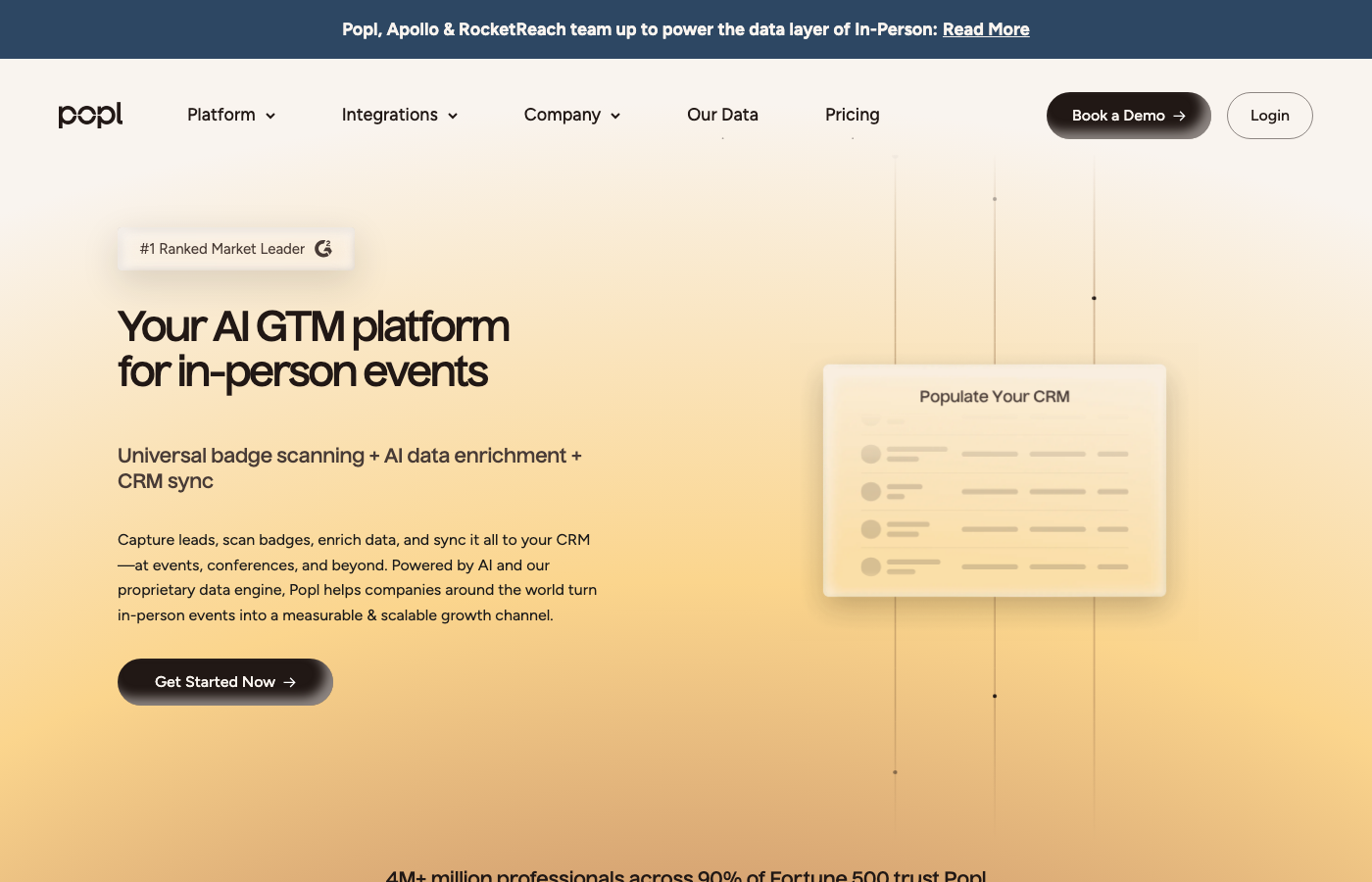
Popl scored 18/30. The Popl app holds a 4.8 on the App Store from over 100,000 ratings, giving it the second-largest review footprint in this roundup. That said, the company has shifted its primary focus to enterprise event lead capture software, and consumer NFC cards are no longer the main product line. Cards sell exclusively through Amazon, and consumer software pricing is no longer publicly listed on the Popl website. If you want an NFC card from a vendor that treats the product as its main business, other options on this list are more committed to it.
| Criterion | Score |
|---|---|
| Pricing | 2/5 |
| Card pricing and materials | 3/5 |
| Form factors | 4/5 |
| Platform features and CRM | 2/5 |
| QR code backup | 5/5 |
| Setup ease and compatibility | 2/5 |
| Total | 18/30 |
Pricing and ownership
Cards sell on Amazon: PVC at approximately $19.99 and metal options also listed. Consumer plan pricing is no longer published on the Popl website, which now focuses exclusively on enterprise event lead capture plans with “request a demo” as the entry point, though Popl’s Amazon listings reference a Pro upgrade at $7.99/month.
The Amazon-only sales channel means you don’t get a bundled trial with your card purchase the way Mobilo or V1CE handles onboarding. For teams, Popl’s pricing requires a sales conversation.
Cards and form factors
The hardware range includes PVC and metal cards, phone stickers, phone cards (thin NFC inserts for phone cases), a keychain, and a bracelet. The product lineup on Amazon covers more form factors than most competitors.
Platform and team tools
The platform’s development resources are aimed at enterprise event lead capture. For individual card buyers, that means a consumer experience that hasn’t kept pace: the website no longer lists consumer plans, and updates to the individual product have slowed. The Amazon listing and the enterprise platform feel like two separate products from two different companies.
Best NFC business card for your situation
Your best card depends on what you need from it. Here are seven common scenarios matched to the provider that fits.
Best value for money
Pick Blinq. The phone sticker starts at $19.99 and you get contact sharing, digital profiles, and QR backup without a subscription. Year one on a metal card runs $49.99 total.
Best for design-first buyers
Dot has the widest selection of colorways in this roundup, giving you more visual options than any other provider on this list. If your card needs to be a conversation piece, Dot is worth the premium. Budget for a paid plan (Plus from $12/month, or team plans from $8/member/month) if you need analytics and export.
Best for custom cards
Blinq’s Custom line prints your logo and design in full color on Classic ($59.99) and laser engraves it on Eco Wood ($69.99) and Metal ($79.99), with bulk discounts applied automatically from 20 cards. Mobilo and V1CE also offer custom printing and engraving, but Blinq’s custom metal is the cheapest here ($79.99, against $139 at Mobilo and about $143 at V1CE).
Best for lead capture
Blinq’s Business plan (from $4.99/user/month, billed annually) includes lead capture with contact enrichment and direct CRM sync, on top of a one-time card purchase. You can collect contact details from anyone who taps your card or scans your QR code. Wave also offers lead capture on its free tier, making it a strong alternative if you want to capture contacts at no recurring cost.
Best for teams
Mobilo’s 90-day Pro trial ships with every card, giving your team CRM sync, branding, and analytics from day one with no commitment. Teams pricing at $4/month per member keeps the ongoing cost low while you evaluate. Blinq’s Business plan (from $4.99/user/month, billed annually) is the other strong contender, with CRM sync, admin controls, and analytics on top of a one-time card purchase.
Best for follow-up automation
V1CE is the only provider on this list that offers automated follow-up email sequences triggered by a card tap. That sits behind the Client Capture OS subscription (~$65/month), but no other card here matches that level of post-tap automation.
Best for enterprise events
Blinq’s NFC cards connect directly to their Event Lead Capture platform, which handles badge scanning, lead enrichment, and CRM sync at event scale. If your team works trade shows and conferences, the same card you use for everyday networking plugs into event-grade lead capture when you need it.
Frequently asked questions
What are NFC business cards?
NFC business cards use a small chip embedded in the card to transfer your contact information to someone’s phone with a tap. The chip is powered by the phone’s NFC reader, so the card never needs a battery or charging. When someone taps your card against their phone, it opens your digital profile in a browser. The recipient doesn’t need to download an app.
Do NFC business cards need a subscription?
Most cards on this list include a free tier for contact sharing and digital profiles. The difference is what each vendor includes at no cost and what sits behind a paid plan. Blinq’s free tier is the most generous (two profiles, QR backup, Apple Wallet), while Wave is the only one with free lead capture. CRM sync and analytics are paid features across most cards in this roundup. V1CE includes a free basic platform with the card purchase, though its advanced features require a paid upgrade.
Can I customize an NFC business card?
Yes. Most providers on this list offer some level of customization, but the options vary widely. Blinq’s Custom line prints your logo and design in full color on Classic cards and laser engraves it on Eco Wood and Metal, with bulk discounts at volume. Dot offers custom cards from $87 per unit. V1CE and Mobilo offer custom printing and laser engraving on their premium cards. The level of design flexibility, minimum order quantities, and turnaround times differ across providers, so check each vendor’s custom options against your specific needs.
Do NFC business cards work with iPhone and Android?
Yes. iPhone XS and later read NFC tags in the background without opening an app, and older models back to iPhone 7 can read them using the Control Center tag reader or an NFC app. Most Android phones with NFC support background reading by default. Every card on this list also includes a QR code backup for devices without NFC. For more detail on compatibility, see NFC business cards: pros and cons.
Are NFC business cards worth it?
For anyone who exchanges contact information regularly, yes. A single NFC card costs less than a box of paper business cards, and the information stays current because you update your digital profile rather than reprinting. The break-even is fast if your current cards go out of date before you use them all.
What is the difference between NFC and QR code business cards?
NFC requires a physical tap, which works only when you’re face to face. QR codes can be scanned from a screen, printed on a badge, or embedded in a presentation. Most NFC cards include a QR code on the back, so you get both sharing methods from one card.
How long do NFC business cards last?
Most NFC business cards use NTAG-family chips, rated for 100,000 write cycles and 10 years of data retention, per the NXP NTAG213/215/216 specification. In practice, the card’s physical durability (PVC, metal, wood) determines its lifespan more than the chip does. Metal and wood cards handle years of daily use without issue.
Try Blinq NFC business cards
See the full range of Blinq NFC business cards, from the $19.99 phone sticker to custom metal cards with your logo laser engraved. Cards are a one-time purchase on a free platform, with free shipping over $30.