


.avif)


Industry trade shows and events have been a major source of marketing and business growth for decades. In the US alone, the value of the events market was estimated at $396 billion in 2025 and is expected to grow by over 11% between now and 2032 (source: AMW). Why are these events so important? Part of the reason is that over 90% of attendees view brands more positively after interacting with them at live events. Their impact isn’t lost on C-suite executives either, as over 80% consider attending in-person events critical for business growth (source: AMW).
The importance of these events is why lead capture apps have evolved so much over the last few decades. Platforms like Blinq recognize that helping brands capture richer leads faster and follow-up more effectively can drastically improve their event ROI. US companies attend almost eight trade shows on average each year and invest over 30% of their marketing budgets on these events (source: Trade Show Labs). It’s not surprising that they’re looking for every possible way to maximize efficiency in this area.
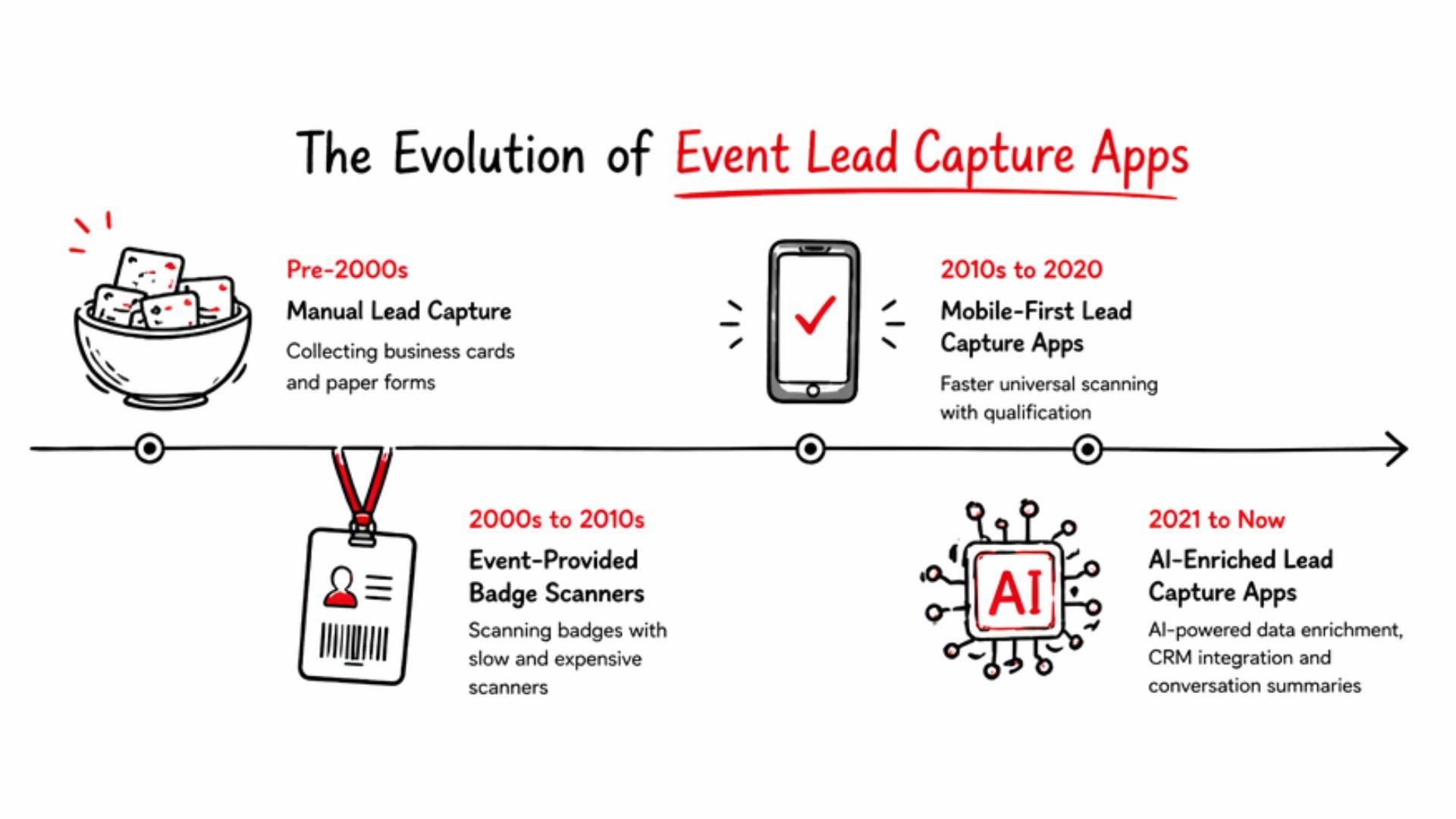
From business cards and paper forms to badge scanners and now AI-powered apps, event lead capture has changed a lot since the pre-2000s. Let’s take a closer look at this evolution and discover how modern technology is supporting event organizers and exhibitors in effective and efficient lead capture.
Key Takeaways (TL;DR)
- Event lead capture has evolved from manual processes with paper forms and business cards to event-provided badge scanners, to mobile-first apps and now to AI-powered apps
- While legacy solutions such as badge scanners remain expensive, time consuming and slow for follow-ups, modern lead capture apps are more affordable, automated and allow instantaneous follow-ups
- Modern lead capture apps help businesses capture and enrich leads and follow up with more context within minutes, increasing response and conversion rates
- The best lead capture apps, like Blinq, offer AI features like data enrichment waterfalls, conversation summaries and deep ROI analysis
- Blinq is the highest-rated event lead capture app on G2 from over 8,800 professional reviews (lead capture, digital business card and email signature services)
- Future evolution of lead capture apps will likely see even more personalization, AI automation, and deeper audience insights
How Trade Show Lead Capture Apps Have Evolved Over the Years
Pre-2000s: Manual lead capture
When companies first started in-person marketing of products and services at trade shows and industry events, they relied purely on capturing leads by hand. They still had booths and handed out freebies or tried to engage attendees in other ways, but when it came to turning booth traffic into leads, they usually needed to collect business cards. The old fishbowl method was employed, and a giant glass bowl would hopefully be filled with business cards by the end of the day.
Not everyone used this approach. Other brands relied on paper contact forms, whereby attendees had to fill out with their details (e.g. phone number, email, company name). You could also employ both business card collection and paper form entry, manually transferring the contact data from the cards to the forms post-event.
Some used mildly more sophisticated methods, using laptops to collect this data. Inputting the details into Excel spreadsheets was often a safer and more secure way of collecting lead data than paper. The latter could easily get lost or damaged by spilt water or coffee. Regardless of the method employed, this was a very manual and time-consuming process that posed a lot of challenges.
The benefits
- Allowed for personal interaction – Physically collecting business cards or writing down attendee details instead of, say, getting people to use a kiosk, resulted in a lot of personal interaction. This was helpful to establish rapport with prospective clients.
- High-quality leads were easily identified – Having conversations with attendees helped exhibitors better identify which ones were more likely to convert. They still needed to track these high-quality leads manually though.
The challenges
- Time-consuming processes – Collecting data by hand and writing out all the contact details was incredibly time consuming. This resulted in longer hours and more investment in staff salaries.
- A lot of human data error – Manual data entry was far more prone to human error, especially when exhibitors were busy. Names, phone numbers, emails and more were inputted incorrectly, resulting in a lot of lost leads.
- Manual entry into CRMs – Collecting attendee data was one thing, but it also needed to be added to company CRMs for tracking. This was yet another manual process that could take days or weeks and cost companies thousands of dollars in staff wages.
- Long delays in following up – All these manual processes took time. It could be days or weeks before sales teams could follow up leads. By that time many of them had gone cold.
- Missed leads during busy periods – When booths became busy, it was common for exhibitors to forget to take down attendee details. Not everyone carried a business card and this extra step could often be forgotten between conversations.
2000s to 2010s: Event-provided badge scanners
Since the 2000’s, event-provided badge scanners emerged as a new way for exhibitors to capture leads during trade shows. It was easier to scan an attendee’s badge and collect their pre-registered data than holding onto their business card or typing out the same details into a spreadsheet. Unfortunately, this was pretty much where the benefits stopped.
Using badge scanners to capture leads remained a manual and slow process. It also cost significantly more. Companies now had to rent the provided scanner hardware, spending anywhere between $200 and $800 per event. Many event badges only provided basic data as well (e.g. attendee name and email). This made it hard for event sales teams to qualify leads and prioritize follow-ups.
The typical process of using badge scanners goes like this:
- Hire your badge scanner before the event for between $200 and $800.
- Collect your hardware from the event when setting up your booth.
- Scan attendee badges when they visit your booth.
- Return your scanner to the event at the end.
- Wait days (or weeks) for the event organizers to send you the spreadsheet with your scanned leads.
- Manually add them to your CRM for tracking.
- Follow-up with leads using the basic information captured with the scanner.
As you can see, the process was very manual. It also lacked lead qualification and was reliant on multiple manual steps happening without issue. Importantly, it still took companies a long time to follow up with leads, resulting in a lot of missed opportunities.
The benefits
- More automated data capture – Companies could scan badges and capture data automatically instead of manually writing it down.
- Easier to scan than manually collect – No need to collect business cards that could be lost between the event and office.
The challenges
- High rental costs – Event badge scanners cost up to $800 per device per event, adding an additional cost for an already expensive marketing channel.
- Unreliable and dated hardware – Old badge scanners could stop working or not scan at times. Sometimes you had to return them during the event and resort to manual lead capture anyway.
- Long data retrieval delays – It would take event organizers days or weeks to share the captured leads from the scanners. You then still had to sift through them, which could also take days. By then many leads had still gone cold.
- No lead qualification or context – Badge scanners only captured basic details. And overreliance on them meant no lead qualification or context to help prioritize follow-ups.
- Inflexible devices – Most badge scanners only worked at a single event. This meant always hiring them and getting multiple lead sheets that needed manual sense-checking before following up.
- No integration with CRMs – You still had to manually add the leads from the badge scanners to your CRM for tracking. This could take days or weeks.
- No event ROI analysis – It was nigh impossible to track event ROI with badge scanners, as they provided no tagging or campaign set-up.
2010s to 2020: Mobile-first lead capture apps
The emergence of mobile-first lead capture apps for trade shows has revolutionized how companies approach this marketing channel today. They’ve given exhibitors a viable and cost-effective alternative to manual data capture. They’ve also helped brands better own their event marketing efforts.
The main way lead capture apps achieved this was by eliminating the need for expensive and unreliable scanning hardware. Instead of hiring event scanners, exhibitors could use their own mobiles as scanning devices through the app. The apps could be used across different events while maintaining the same workflow. Over time as technology advanced, they could also scan various ID types, not just event badges. This included business cards, LinkedIn accounts and QR codes.
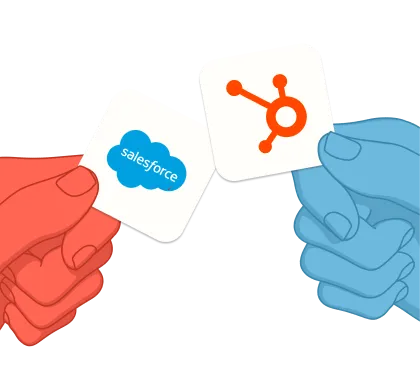
With these apps came much faster lead capture, thanks to native CRM integrations. Unlike badge scanners, lead capture apps provided real-time, automated syncing with major CRMs (e.g. HubSpot and Salesforce). Captured leads were automatically added to CRMs within minutes. Exhibitors no longer needed to wait days or weeks for event organizers to share the data. They could follow up with leads within minutes. For example, across thousands of lead scans on Blinq in the last 12 months, the median time between scan and CRM sync was 90 seconds (source: Blinq proprietary data).
This was a game changer considering following up leads within five minutes increases your odds of making a sale by 21 times compared to waiting 30 minutes, let alone multiple days (source: MIT Lead Response Management Study, Oldroyd, 2007). It also meant fewer leads were lost due to human error during manual data entry or leads going cold while sales teams waited for the data.
The benefits
- Universal scanning – Apps could scan various ID types, including business cards and QR codes.
- Reduced human error – More automated processes, such as data capture and CRM syncing, meant minimal to no human error.
- Offline functionality – Mobile apps could still scan and capture leads without internet connection, functioning like badge scanners.
- Customizable qualification forms – Lead capture apps let brands define their own lead qualification criteria instead of adhering to whatever details the event captured during attendee registration.
- Lead scoring and prioritization – Exhibitors could also prioritize leads based on predetermined qualifiers, making follow-ups more strategic and efficient.
- Immediate CRM syncing – Apps synced captured leads immediately to CRMs with their native integrations. Sales teams no longer needed to wait days or weeks for contact data to follow up.
- Fast follow-ups – This CRM syncing lets sales teams follow-up leads within minutes, contacting hot leads instead of cold leads after days or weeks of additional work.
- Lower overall costs – Mobile apps are a fraction of the price of badge scanners, helping brands maximize their event ROI by cutting costs.
- Flexibility – Lead capture apps can be used at any event and simultaneous events.
- Event ROI analysis – Apps allow for deeper ROI analysis, providing campaign tagging to differentiate events and help companies choose trade shows more strategically.
The challenges
- Conversation context still manual – At this point the lead capture apps didn’t capture conversation context. This still required manual input, which took time and effort.
- Pricing models weren’t always beneficial – Some apps were only available on a fixed-fee pricing model. This didn’t suit companies that only attended a few events each year.
- Reliance on staff mobiles – Mobiles weren’t infallible. Apps could stop working, and mobiles sometimes ran out of battery.
- Limitations with badge-kit APIs – At big trade shows, where event badges were used almost exclusively, the mobile apps wouldn’t always capture the full extent of event registration data due to not having the badge-kit API.
2021 to Now: AI-enriched lead capture apps
The latest evolution of event lead capture apps includes the integration of innovative AI features. These have not only solved many of the challenges present in early apps, but they’ve also unlocked new value and provided access to additional data for attribution and analysis.
The workflow efficiencies AI provides for lead capture are becoming necessary for keeping up in a highly competitive marketing channel with the emphasis now on fast and contextual follow-ups with leads. The sales teams that follow up fastest are the ones using lead capture platforms with AI support.
There are three main ways AI helps you capture richer leads and follow-up faster:
- AI enrichment: AI can enrich the lead data you capture, filling in any missing fields on lead data captured (e.g. verified email address, phone number, LinkedIn profile). A modern platform like Blinq uses a data enrichment waterfall combined with AI to do this with maximum effectiveness. It’s essentially a process where a series of reputable third party providers are queried in a fashion directed by AI to maximise the total set of data able to be returned. If an accurate source is not available, it leaves the field blank. This helps prevent missing data that otherwise would stop sales teams from following up leads quickly (or at all).
- AI note taking: AI can record your conversations and/or personal notes during an event and provide detailed summaries with follow-up suggestions. This isn’t available for all lead capture apps. Blinq is one of the only ones that provides its proprietary feature, AI Notetaker, which can achieve this outcome. Conversations captured via AI Notetaker are followed up 3.4x faster on average than scans without context (source: Blinq proprietary data).
- AI follow ups: AI can write your follow-up emails, saving your sales teams time and effort writing the emails themselves while helping you send follow-ups a lot faster.
These core automations alone have enabled exhibitors to entirely change the way and speed in which they follow up with leads.
With AI-powered lead capture apps, such as Blinq, you can more easily qualify leads through recorded conversations you have with each attendee. You no longer need to manually jot down someone mentioned having budget ready to go. An AI notetaker will do that for you and present it within its summary as a key point for following up.
AI data enrichment also helps these apps ensure practically 100% of all leads are completely captured. No missing phone numbers. No missing emails. No figuring out someone’s job title or company to determine their follow-up priority. The information is sourced and included by AI.
With these, plus automated emails written by AI, we’re seeing sales teams sending follow-ups faster than ever before. These follow-ups are more personalized, too, picking up conversations where they left off instead of doing all that work again.
The benefits
- AI data enrichment waterfalls – These ensure leads are complete with important contact and qualifying data gathered from reliable sources when not included with your initial scan. Blinq’s enrichment waterfall returns a verified email for 94% of scanned leads. This is over 30% higher compared to emails included in raw badge scanner exports (source: Blinq proprietary data).
- Deeper event ROI measurement and maximization – AI can help lead capture apps provide deeper insights into event-specific and exhibitor-specific ROI. Now you can find more ways to maximize your efficiency at events.
- AI-generated conversation summaries – Relevant notes from conversations with attendees help your follow-ups feel more personalized and relevant, prompting a higher response rate.
- Real-time behavioral data – AI-powered behavioral tracking provides data on booth visits, session attendance, content downloads, networking and more. This provides real-time insights into how your booth resonates with attendees and how you can adapt your engagement strategies on the fly.
- Automated follow-up emails – AI-drafted emails help sales teams send follow-ups faster to more leads, helping your brand connect with attendees before any of your competitors.
The challenges
- AI data enrichment accuracy – Not all lead capture apps have the same level of data enrichment accuracy. While apps like Blinq are known for consistently providing over 95% accuracy with their data sourcing, others require far more human intervention to sense-check data and identify incorrect fields.
- Human writing intervention – AI-automated emails can still require human editing and sense-checking if you want to keep a human in the loop. Impersonal tones and missing information can occur depending on the quality of the prompt and context provided to the AI.
- Integration complexity with CRMs – To get the maximum value out of all AI features, more complex integrations are often required. However, certain lead capture platforms, like Blinq, are better at integrating with major CRMs than others.
AI-Powered Lead Capture Apps for Trade Shows Vs. Badge Scanners
The table below is an overview of how Blinq’s trade show lead capture app compares to traditional badge scanners. Keep in mind that not all lead capture apps have all of the features listed below. If you want to learn about specific apps and their benefits, read our in-depth comparison of the best event lead capture software.
| Feature | Blinq’s Lead Capture App | Badge Scanners |
|---|---|---|
| Scans any badge, business card, text or QR code | ||
| Works across any event | ||
| AI-powered conversation notes | ||
| Voice memos with transcription | ||
| AI-generated follow-up emails | ||
| Instant follow-ups | ||
| Real-time CRM integration and syncing | ||
| Offline lead capture with online CRM syncing | ||
| Lead qualification (custom questions, scoring etc.) | ||
| AI data enrichment | ||
| Event analytics and insights | ||
| Automated workflows | ||
| Bulk exports | ||
| Delayed access to lead data (24—48 hrs) |
How Modern Lead Capture Apps Help Businesses Succeed at Events
These days, marketing success at events (i.e. capturing leads that convert to sales) comes down to four main elements that exhibitors need to consistently hit on:
- Capturing leads leveraging a variety of input types (not just event badge scanning) to suit modern-day events and shows.
- Capturing leads in a way that instantly qualifies them based on your unique criteria to help prioritize sales calls and follow up prospects that can actually convert.
- Following up with attendees within minutes instead of waiting hours or days.
- Following up with a relevant message that shows attendees you remember them, their business needs and what you talked about – proving this is more than just a generic follow-up email.
Modern lead capture technology helps you achieve all four of these elements at every event and trade show you attend. While there are obviously other aspects that are important, these four stand out in today’s event marketing world as crucial differentiators between brands that succeed at events and those which consistently struggle to maintain a positive ROI.
Building an efficient event-to-pipeline program
Hitting on these four elements allows you to build effective event-to-pipeline programs where exhibitors and sales teams operate with the same priorities.
Traditionally, exhibitors were focused on capturing as many leads as possible, regardless of their qualification. This didn’t help sales teams who wanted to contact leads with actual conversion potential. Today, you can align these priorities with modern lead capture tech. Exhibitors can automatically qualify leads for sales teams to prioritize within minutes.
Immediate and relevant follow-ups with conversation continuity can increase response rates by over 20% and improve overall event ROI by more than two times (source: LinkedIn Case Study). The easiest way to ensure you’re doing this is by using a well-equipped lead capture app with AI integrations.
How Event Lead Capture Technology May Evolve in the Future
It’s hard to predict how event lead capture software will evolve. However, if it continues following recent trends, we can expect to see more automation, data intelligence, personalization and integration provided by AI. This isn’t exactly new. AI is at the forefront of most technology these days and it should continue to adapt and grow within the event lead capture space, too.
Here are some evolutions we might see within lead capture apps:
- No more scanning, only autonomous capture – AI tools automatically extracting data from IDs and conversations instead of exhibitors having to physically scan a business card or QR code (based on event tech professional Paul Singh’s LinkedIn article on AI lead capture).
- AI sales assistance requiring less human intervention – As AI develops sufficient context and ability to better communicate through follow-up emails, we should see little or no time needed for editing or sense-checking (based on the emergence of AI sales assistance platforms as reported by ZoomInfo).
- Personalized offers – On top of conversation context, AI tools may be able to provide personalized offers to leads determined by things they discussed with the exhibitor, cutting down on steps in the sale journey (based on the McKinsey Quarterly article on personalized marketing).
- Predictive lead scoring – Instead of determining a lead’s value based on fields in a qualification form, AI tools will be able to predict whether a lead is hot or cold based on their behavior, engagement at your booth, professional history and other details (based on Rebecca Tebbutt’s article for The Insight Collective).
Why Blinq is the Top-Rated Lead Capture App for Events & Trade Shows
While there are numerous platforms embracing the modern approach to AI-powered lead capture at events and trade shows, Blinq is the top-rated lead capture app on G2 from over 8,800 professional reviews covering its lead capture, digital business card and email signature services. It’s considered the leader in this space and one of the top two easiest to use apps. Blinq is also the top-rated lead capture app on the App Store with a 4.9-star rating from over 124,000 ratings.
Here are some of the reasons why event marketers and sales teams rate Blinq so highly:
1. AI Notetaker
It’s one of the only platforms with a fully fledged AI note taking feature. Other popular brands, such as Popl and Mobly, don’t have this for users.
2. Fast CRM syncing
Blinq has one of the fastest scan-to-CRM speeds in the industry. You can usually expect to have lead data available on your CRM within seconds of creating a lead.
3. Scalability
Blinq has proven itself as a reliable lead capture tool for brands operating at various scales. The usage-based pricing model and overall affordability help companies incorporate lead capture software with their event marketing efforts regardless of what point they’re at. New and established marketers attending a few or double-digit events each year can get the same value out of Blinq.
If you feel Blinq is the right lead capture platform for your needs, you can get in touch to book a demo. We also recommend learning more about Relationship Intelligence, our suite of lead capture features that are helping businesses increase their ROI at in-person events.
Frequently Asked Questions
How has event lead capture technology evolved over time?
The evolution of event lead capture has moved from manual data capture through paper forms and collecting business cards to mobile-first lead capture apps with AI integrations. This has led to more automated workflows and less manual work from exhibitors and sales teams. It has also meant almost 100% of leads are successfully captured, qualified and followed up with conversation context.
What are the limitations of traditional badge scanners at events?
Badge scanners have numerous limitations, mainly that they only captured basic attendee data and didn’t include any qualification, prioritization, validation or conversation context. They were also very expensive, costing hundreds of dollars to rent per event. The hardware was outdated and unreliable, could only scan event badges and took days or weeks to sync contacts to CRMs post event.
Why are companies moving from hardware badge scanners to mobile apps?
Lead capture apps for events mean companies no longer need to pay for expensive, event-specific badge scanners that are unreliable and slow. Companies opt for mobile apps because they want instantaneous lead capture and follow-ups. They also want more automated lead qualification, data enrichment, conversation context and streamlined workflows. Mobile apps also provide ROI reporting and a more scalable cost that benefits exhibitors more than events.
What role has AI played in transforming event lead capture?
AI has made lead capture more than just data collection. With AI, companies can enrich data, add conversation context to follow-ups, and automate a lot of the process. The data processing and analysis also helps sales teams action real-time insights and prioritize high-value leads, resulting in higher conversion rates and overall ROI increases.
Are badge scanners still relevant in 2026?
Yes, badge scanners are still used today. You’ll see them primarily at larger trade shows where standardized scanning hardware is more commonplace. However, they are becoming increasingly irrelevant compared to modern lead capture technology. Badge scanners are often used alongside these apps or replaced entirely by them.
Can AI automatically qualify leads during conversations?
Not all but some AI-powered lead capture tools can qualify leads during conversations. They record and analyze conversations, using keywords, direct answers and overall engagement to score leads based on their expectancy to convert.
Are event lead capture apps GDPR and privacy compliant?
Most event lead capture apps will comply with GDPR and other data protection regulators. Consent tracking, secure data storage and user access controls are some features that ensure this compliance. However, you should always verify the app’s compliance features before using it at an event.
Will AI replace manual lead qualification entirely?
No, it shouldn’t completely replace human input entirely. Events are strong marketing channels because of their face-to-face element. If they lose this, they’ll lose their impact on sales and deals. Humans will still be needed for establishing these personal connections. AI will be a strong supporting tool, letting actual exhibitors focus less on admin tasks and more on building relationships with attendees.
How will wearable tech or smart badges impact lead capture?
This technology could make lead capture more seamless and passive. You may not have to scan anything as the tech can automatically track your interactions and qualify leads based on engagement and conversation. It could make booth encounters more organic and effective for lead capture.