




.avif)


Lead enrichment is the process of taking a contact record you already hold and filling in what's missing from outside data sources. You start with something small, a name and a company, an email address, a badge you scanned at an event, and the tool looks that person up and returns the rest: job title, phone number, company domain, LinkedIn profile, company headcount, etc.
How much of that comes back depends on what you handed over, and some of what does come back will be wrong. The rest of this page covers where the data actually comes from, why fields turn up empty, how to read the match rates vendors publish, and what the law asks of you once you have enriched somebody.
Key Takeaways (TL;DR)
- Lead enrichment completes records you already have. It fills in missing fields on a contact from outside sources. Finding you new people is a different job.
- What you hand over shapes what comes back. A record that starts with a company domain and/or a LinkedIn URL typically comes back fuller than one carrying a name+company combination alone.
- Most tools query one source at a time and stop at the first that answers. Two tools can hold the same data, ask in a different order, and hand back different answers for the same person.
- Empty fields usually have a structural cause. The lookup can be set to stop before it tries phone or email, it can quit when it can't match a person, or it can reach every source and find nothing on them.
- A filled field can still be wrong, and only one field has been measured independently. In a 2026 benchmark of mobile numbers, 60% of the numbers that passed a validity check reached the right person.
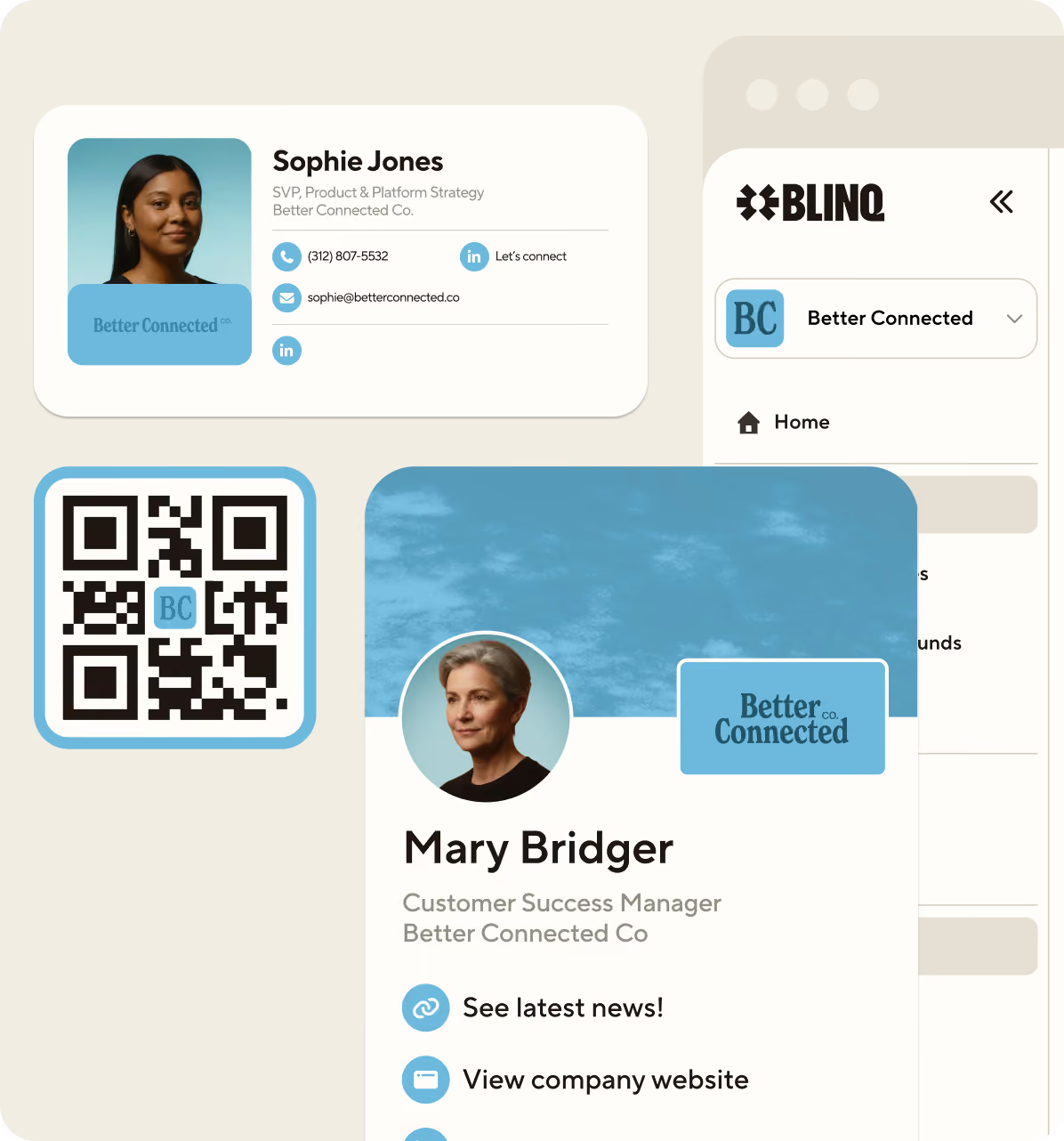
- A lead enrichment tool, like Blinq's, runs the lookup and writes the result into your systems. It might be a standalone platform, a feature of the tool you capture with, or a module inside your CRM.
What is lead enrichment?
Lead enrichment takes a contact record you already hold and completes it from external data sources. A lead arrives with a few fields filled and the rest empty, and enrichment fills what it can find from data that already exists somewhere else.
The fields sort into three groups.
The three groups of fields enrichment tries to fill.
The obvious question is where any of that comes from, and the honest answer is that it was already public or already sold. Professional profiles and company websites carry most of the job titles, company names and headcounts. Email addresses are usually pattern-matched against a company's known format and then tested by sending a probe that checks whether the mailbox exists without delivering anything. Phone numbers are the hardest, and they mostly come from data companies that compile and license contact records. None of it is magic and none of it is your CRM talking to somebody else's.
A lead enrichment tool is the software that runs this lookup and writes the result into your systems. It might be a standalone platform, or a feature of the tool you capture with, or a module inside your CRM.
In certain cases some enrichment tools also return technographic data, meaning the software a company runs, and intent data, meaning signals about what a company is researching. Those are usually priced as separate products. This page covers the contact and company fields.
How is lead enrichment different from lead generation and lead scoring?
Lead generation finds people you didn't have. Lead enrichment completes the records you already have, filling in the fields that were left blank. Lead scoring ranks those records once they're filled, so it runs after enrichment and depends on it. All three get sold together and they solve different problems.
Lead scoring is worth separating too, because the two get bought together and they fail together. A score is only as good as the record underneath it. Score a half-empty contact and you have ranked it by how much you happen to know about it.
Do you need lead enrichment?
You need enrichment when you're holding records you can't act on and the missing piece is data somebody else already has. It's a volume problem as much as a data problem. A list short enough to fix by hand should be fixed by hand.
You captured people faster than you could type at an event. You inherited a list thinner than the pitch suggested. You're routing on fields that are half empty, which means the rules that decide who gets which lead are firing on guesses. Somebody handed you a company name and asked you to find the right person to call.
How does lead enrichment work?
Enrichment works by matching an identifier you already have against external data sources, appending what those sources return, and writing the result back to your record. An identifier is any field specific enough to pin down one person: an email address, a full name plus a company, a LinkedIn URL, or a badge scanned at an event. A first name on its own is not one.
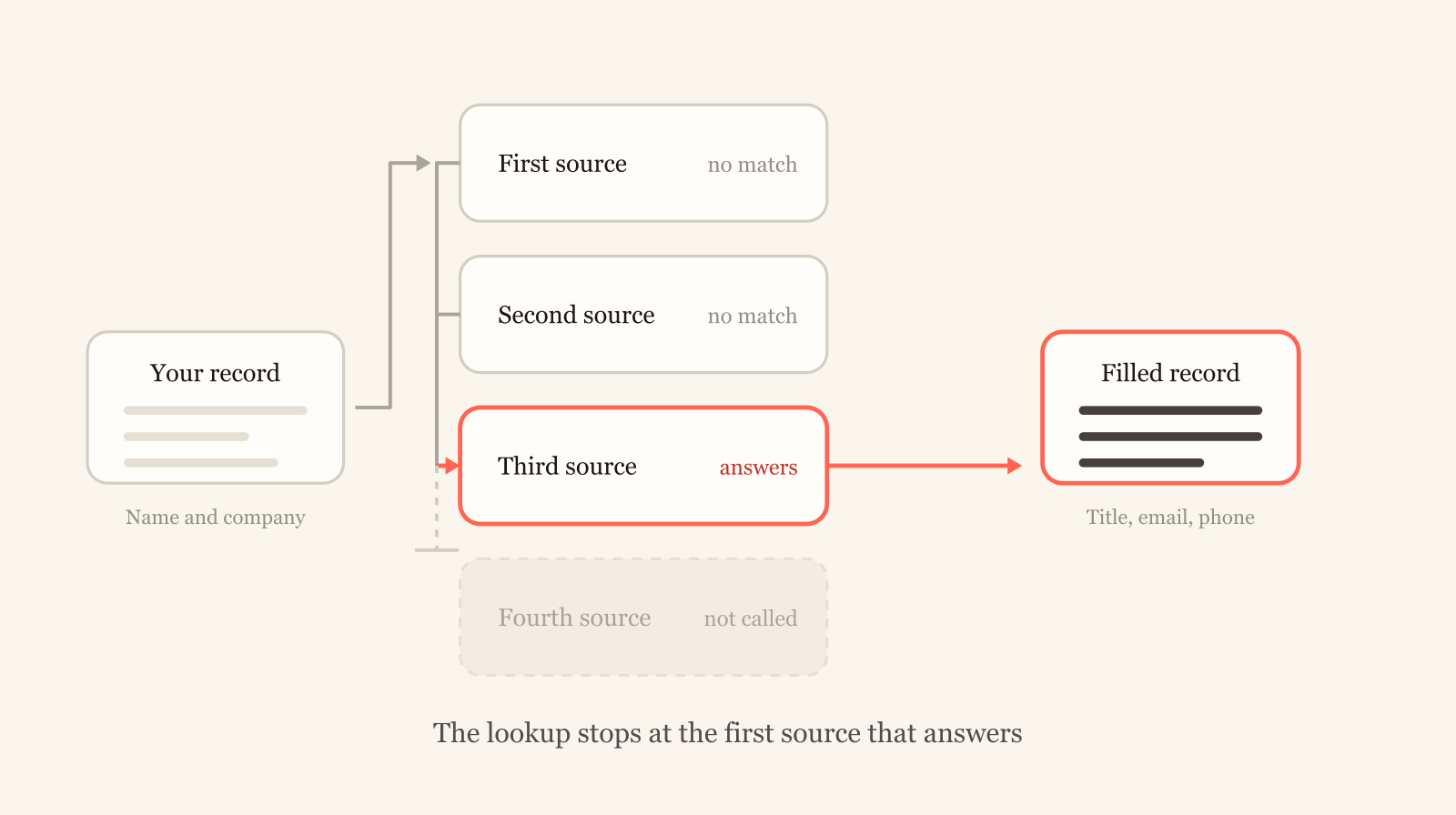
Most tools run that lookup as a waterfall. Sources are queried one at a time in a set order, and the lookup stops as soon as one of them answers. The tool pays for each source it calls, so calling fewer of them is cheaper, and that is the whole reason the order exists.
That order has a consequence worth knowing before you compare vendors. Each tool works through the sources in its own sequence, and the sources hold different values for the same person, so a tool stops on whichever value it happened to reach first. A tool licensing the same data as its competitor can still report a different job title. Neither one is malfunctioning, and it is the reason a trial run on your own list tells you more than a comparison of two published figures.
An identifier you get back at one step can feed the next one. If an early source returns a LinkedIn URL you didn't have, later steps can use it to find things they would otherwise have missed, which is why a record that starts with more comes back with disproportionately more.
When does lead enrichment run?
Enrichment runs at capture, on a schedule, or in a bulk job against a list you already hold. Data ages from the day you collect it, and a record enriched on arrival never sits in a queue waiting for somebody to remember it.
The three moments enrichment can run, and the catch on each.
Blinq's lead enrichment runs at capture, so Blinq fills the contact before you have walked away from the conversation. Meeting somebody face to face has a second advantage here, which is that you can check a detail with them while they are standing in front of you. The same applies to anything captured in person, including lead retrieval at events.
Why does lead enrichment leave fields empty?
Lead enrichment leaves fields empty for reasons that are mostly structural rather than random. The lookup may be configured to stop after the cheap sources, before it ever tries phone or email. It returns nothing when no source matches the person. It skips steps that needed an identifier nobody supplied.
Those three are all the waterfall doing what it was set up to do. The fourth is different: every source it reached can simply hold no record for that person.
Enrichment returns only what somebody has already published or licensed, so a person with a thin public footprint comes back thin. Adding providers does not change that.
A blank is usually evidence about the record you supplied, or about the person, which makes it worth capturing more at the point of contact. Use an AI notetaker to dictate a voice note while the detail is fresh, and scan the badge or the business card rather than pocketing it.
How accurate is enriched data?
Published match rates in this category sit high. Blinq publishes a 90%+ match rate on emails and an 80%+ find rate on phone numbers. Email is the easier of the two to stand behind, because an address can be checked before it is handed over, by sending a probe that confirms the mailbox exists.
How close any list gets to a published figure depends on who is on it. A rate measured on senior people at large companies will not repeat on a list captured through a form that asked for a first name and an email address, and that is a fact about the list rather than a failure of the tool.
Independent measurement is thinner on the ground. The one benchmark anybody has published tested mobile numbers from ten data providers, which did not include Blinq: of every valid mobile, 60% were the right person, in a 2026 test Elric Legloire at Outbound Kitchen funded and ran himself. That is the difference between a value arriving and a value being right.
A field can also come back filled and out of date. A job title somebody left eighteen months ago looks identical on the screen to a current one, and nothing in your routing rules will catch it.
How should you read a match rate?
A match rate is the share of records a vendor filled out of the records it was given. On its own it doesn't tell you much, because the terms underneath it can be defined several different ways, and two vendors quoting the same number may have measured very different things.
Five questions to ask about any published match rate.
Vague answers are not automatically bad faith. Some of these are hard to measure and some vendors have never been asked. Their answers tell you which parts of a number you can plan against and which parts you would want to test on your own data.
What will enrichment find for your own list?
What enrichment finds on your list depends on what the list already carries, so sort it by how you captured the records before you spend anything on it.
Sort your list by capture method before you enrich it.
The fields behave differently too. Job title and company are the easiest to fill, because they sit on a public profile somewhere, and they are also the first to go stale when somebody moves. Direct phone is the hardest to fill and the most expensive when it's wrong. A company domain changes when the company rebrands or gets acquired, and not otherwise.
So test it before you commit. Ask any vendor for a run against 200 rows of your own list, count the filled fields by field type, and check a sample by hand. A trial run is still a disclosure to a third party, so strip the names first, or get a data processing agreement signed. That is the contract governing what a vendor may do with data you send them.
If you're picking vendors to test, our guide to the best lead enrichment tools compares the main options.
Where does enriched data end up?
Enriched data lands on your CRM record. From there it feeds the routing rules that decide who owns the lead, the segments you build, and the first email somebody writes to them.
Which is what makes a half-filled record more dangerous than an obviously empty one. Nobody routes an empty record, so somebody has to look at it. A half-filled one flows straight through the rules as though it were complete.
What does privacy law require when you enrich someone's data?
When you enrich, you obtain personal data about someone from a source other than that person. The GDPR attaches disclosure duties to that, and so do California's privacy rules. Those duties land on you, the business doing the enriching, rather than on the vendor you bought the data through.
Under the GDPR, Article 14 covers information you have to provide when you didn't get the data from the individual. It sets timing triggers rather than a single deadline, and the one that usually governs a sales workflow is this: if you're going to contact the person, you tell them at the latest when you first make contact. In practice the disclosure belongs in your first email.
California asks for a notice at collection. 11 CCR 7012(h), a regulation adopted by the California Privacy Protection Agency and operative since March 2023, excuses a business from that notice only when two things are both true: it neither collects nor controls the collection of the information directly from the consumer, and it neither sells nor shares it. If you scanned the badge, ran the webinar or hosted the form, you controlled the collection, so the first condition already fails and the notice duty is yours.
None of this is legal advice. Each regime turns on facts about your own business. Take your situation to counsel before you build a process on it.
Enrich at the point of capture
Most of what decides your results happens before any vendor sees your list: what you collected, and how long ago. Those are yours to control, and they are at their best the moment a contact is created. See how Blinq's lead enrichment completes a contact at the point of capture.