



.avif)

You meet someone worth knowing, reach for a card, and hope it doesn't vanish into a coat pocket you never check again. Usually it does: a widely cited 2016 figure published on Adobe's blog puts it at 88% of paper business cards thrown out within a week. That's the real question behind paper vs digital business cards in 2026. What matters is less how the card looks in the hand and more whether it's still working for you a week later. On that test, and on cost, digital wins for most people. Paper still earns its place in formal rooms and as a premium object worth holding. This guide compares them on what decides it, cost, first impressions, and what survives the handshake, then shows the hybrid option that gets you both.
A note on examples: we use Blinq as the running digital business card in this comparison, because it's the platform we build and know best. The criteria apply to any digital card, so weigh them against whichever tool you're considering.
Key Takeaways (TL;DR)
- Digital wins for most people: it costs less, updates in one place, and turns a handshake into a saved contact you can follow up on.
- Cost: a free digital plan is $0, while an active networker spends roughly $120 to $275 a year on paper at print prices checked in July 2026. Even at low volume, free beats a box of cards.
- Retention is the deciding gap: Paper cards are easily lost or tossed after the exchange, while a saved digital contact stays in the recipient's phone.
- First impressions still favor paper in formal rooms: 72% of people judge a business by the quality of its card, so a premium card lands with traditional audiences.
- Paper's other problem is the pile: cards collect in a drawer or a bag and rarely make it into a CRM, which is part of why people are moving to digital.
- The hybrid gets you both: an NFC card or a QR code printed on premium paper keeps the tactile handover with live digital details underneath.
Paper or digital business cards: which should you use in 2026?
For most professionals in 2026, a digital business card is the better default. It costs less, keeps your details current, and turns a first meeting into a contact you can actually follow up on. Paper still wins in formal and traditional settings, where the physical handover signals respect, and as a premium object people remember holding. For most people the strongest setup is a hybrid: digital every day, premium paper or NFC for the rooms that expect it. The sections below show the cost math, the first-impression evidence, and where each format earns its place.
Paper vs digital business cards at a glance
Here is how the two compare on the dimensions that decide it. Each row gets its own section below, so you can see exactly where paper holds up and where digital pulls ahead.
| Dimension | Paper business card | Digital business card |
|---|---|---|
| 12-month cost (active networker) | $120 to ~$275 (print prices, July 2026) | $0 on most free plans |
| First impression | Strong with traditional audiences; quality matters (72% judge by it) | Reads as current in tech, sales, startups |
| Retention after the exchange | 88% discarded within a week (Adobe, 2016) | Saved to the recipient’s phone |
| Keeping details current | Reprint the batch | Edit once, live everywhere |
| Follow-up and capture | Manual; one-way unless they reciprocate | Two-way; contact and notes can sync to a CRM |
| Works with no signal or battery | Always | QR and wallet passes work offline; depends on a charged phone |
| Team management | None once printed | Central templates, updates, revocation |
Why are people switching to digital business cards?
People switch for four reasons: cost, currency, capture, and clutter. A free digital card costs nothing, updates everywhere the moment you change a detail, and saves straight into the other person's phone. Paper does none of that, and it piles up. The stack of cards in a drawer or the bottom of a bag rarely makes it into anyone's CRM. When the goal is a contact you can act on later, digital removes the steps where paper leaks.
Cost: which is cheaper over 12 months?
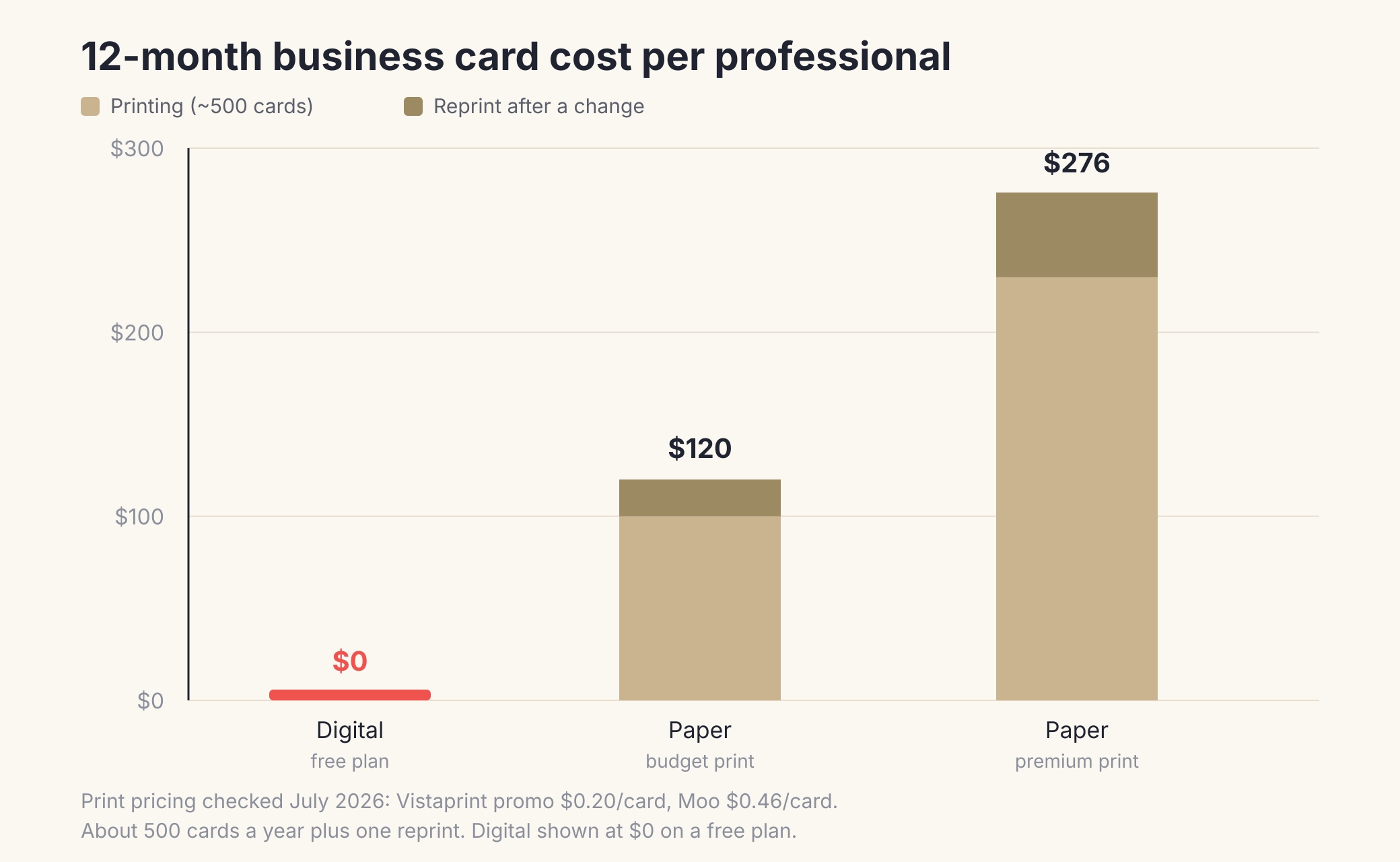
Digital is cheaper for almost everyone, because most digital business cards, including Blinq's free plan, cost $0. A year of paper runs about $120 to $275 for an active networker at print prices checked in July 2026, and company card programs have run $40 to $80 per employee. Even if you hand out only a handful of cards a year, a free digital plan still costs less than a single box, and it adds capture and live updates a box can't.
The assumptions, in the open: one active networker handing out roughly 500 cards a year, with one mid-year reprint after a detail change. Print anchors checked July 2026: Vistaprint standard cards from $10 per 50 ($0.20 per card, a promotional price that can change) and Moo Original cards from $23.00 per 50 ($0.46 per card).
| Line item | Digital | Paper, budget printing | Paper, premium printing |
|---|---|---|---|
| Design | $0 (built-in templates) | $0 (printer template) | Varies (custom designer) |
| Printing, ~500 cards | $0 | $100 at $0.20/card (Vistaprint, promo) | $230 at $0.46/card (Moo) |
| Reprint after details change (~100 cards) | $0 (edits update live) | $20 | $46 |
| Cost per contact who keeps your details | ~$0 marginal | ~$1.67 per kept card | ~$3.83 per kept card |
| 12-month total | $0 free plans; paid tiers vary | ~$120 | ~$276 |
A note on "cost per kept card": some digital vendors apply Adobe's 88% discard rate to inflate paper's effective cost per contact. It's shown for completeness (a $10 box of 50 with 6 kept works out to about $1.67 per kept card), but treat it as framing rather than a bill, since your printer charges for every card whether or not it's kept.
If you barely hand out cards: at fewer than 50 a year, a single $10 box can last you, and paper costs almost nothing. Even then a free digital plan undercuts it at $0 and keeps your details current, so the money question rarely favors paper. Premium stock still buys more impression per dollar if a beautiful card is the whole point. Paper's price advantage is really "cheap," never "cheaper than free."
Cost is also the objection finance teams raise. A buyer at a nutrition company evaluating digital card platforms told Blinq that at a few thousand dollars a year, "accounting would be involved and say... what is the advantage here in terms of just continuing with paper cards?" For a team, the spend buys contact capture, CRM sync, always-current details, and centralized control, none of which a reprint order includes.
First impressions: which lands better in the room?
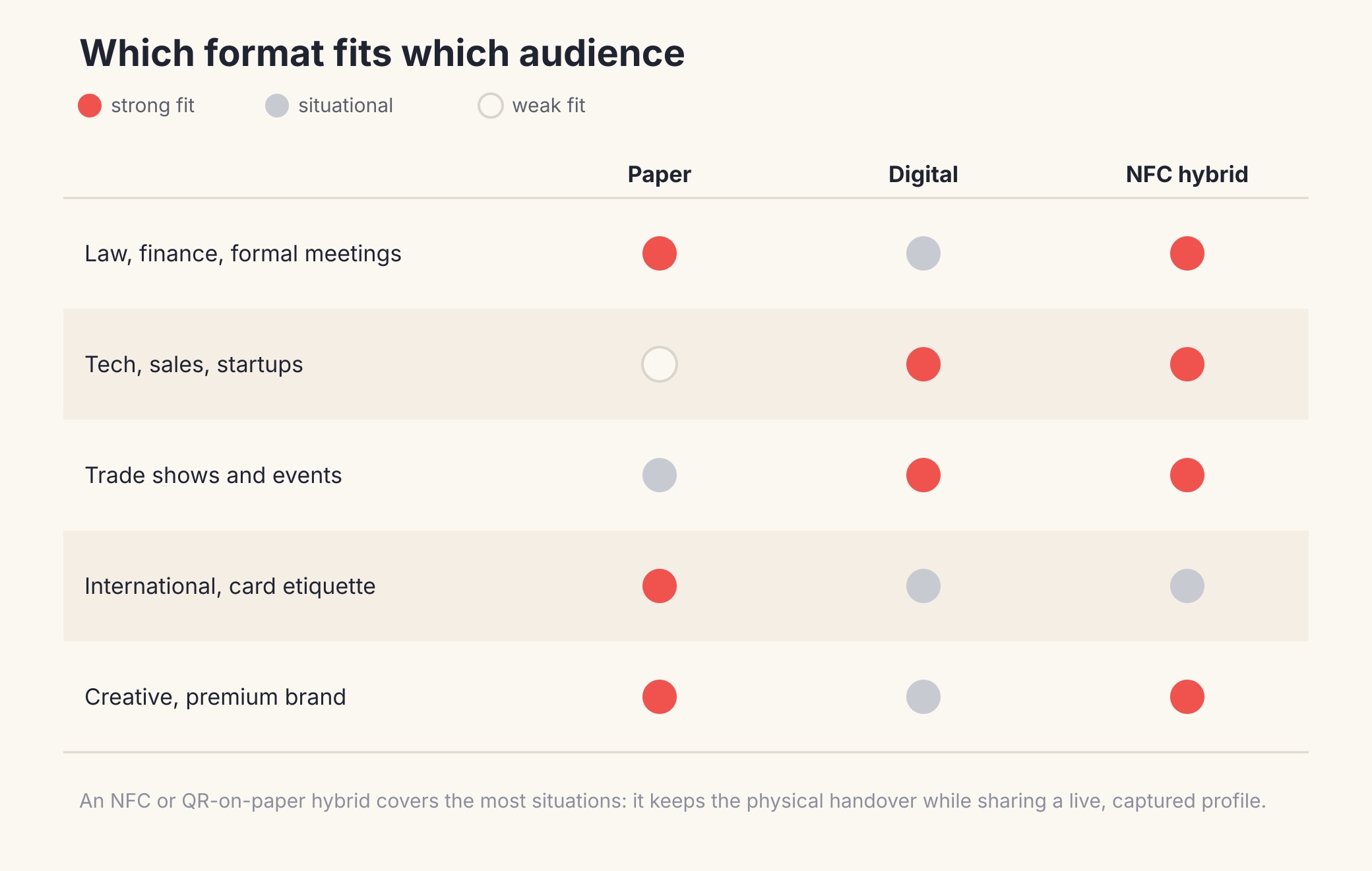
It depends on the room. In formal international business and in certain industries, a quality paper card signals respect, and 72% of people judge a business by the quality of its card, with 39% put off by one that looks cheap. In law, tech, sales, and startups, a well-designed digital card reads as current and puts your details one tap from saved. No independent academic study crowns either format on first impressions, and most head-to-head claims come from digital-card vendors, so match the format to the audience rather than a leaderboard.
Paper: the tactile handover is memorable, and premium stock lands in traditional and senior rooms where a phone screen can feel casual.
Digital: a clean profile reads as current, carries more than a name and number, and saves in one tap so nothing is retyped later.
After the handshake: which card survives?
This is where digital pulls ahead. Adobe's 2016 analysis found 88% of paper cards are thrown out within a week, and it linked every 2,000 cards handed out to a 2.5% lift in sales, so the card that survives is the one still working for you later. A digital contact saves to the phone and stays there. A paper card usually doesn't, and the ones that aren't tossed pile up unsorted in a drawer. Retention, more than the handover, is the real difference, which is part of why physical business cards keep losing ground.
Keeping your details current
Change jobs, numbers, or a title and paper turns stale the same day. Paper: reprint the batch and redistribute, which costs money and time, and the cards already handed out stay wrong forever. Digital: edit once and every card you have ever shared updates live, so the person who saved you last year sees today's details. For anyone whose role or company changes, this alone can tip the decision.
Follow-up and lead capture
Paper is a one-way handoff. Digital makes the exchange two-way and keeps a record. Paper: you hope they save your details, and you copy theirs down by hand later. Digital: the contact and your notes can sync to a CRM, so a name from a busy event floor becomes a tagged lead before you leave the venue.
The workflow habit is real, though, and it cuts both ways. A business development lead at a destination marketing organization told Blinq their team is "still pretty dependent on our paper cards" and tends to "just get a paper card and rubber band it and bring it back to the office." A digital card only beats the rubber band when the captured contact flows into the CRM with the right event tag attached. Set up that way, it removes the manual step instead of adding one.
Reliability, security, and team control
Paper always works. Digital needs a charged phone, though QR codes and wallet passes still open offline. Where digital pulls clear ahead is control. Paper: once printed, a card can't be changed, tracked, or recalled. Digital: enterprise platforms hold SOC 2 Type II compliance, give admins central control over employee cards, and let you update or revoke a card the day someone leaves. Blinq, for example, holds SOC 2 Type II and is rated #1 in digital business cards and lead capture on G2, with 4.9 stars across 150,000+ reviews and 4 million users.
When does paper still make sense?
Paper earns its place for real reasons, and pretending otherwise makes the digital case weaker. It stays the better call in five situations:
- Traditional audiences and formal industries where the handover is expected courtesy.
- Cultures with card etiquette, like Japan's meishi exchange, where the card is received with both hands.
- Environments where phones are away: secure sites, some trade floors, black-tie events.
- Deliberate brand statements, where an ultra-premium letterpress or metal card is the object itself.
- A backup for when a battery dies or a signal drops.
There is also a cost paper carries beyond the print bill. Printers produce an estimated 27 million business cards a day, and with 88% discarded within a week, most of that paper is waste, which matters to buyers weighing sustainability commitments.
The hybrid: NFC cards and QR codes on paper
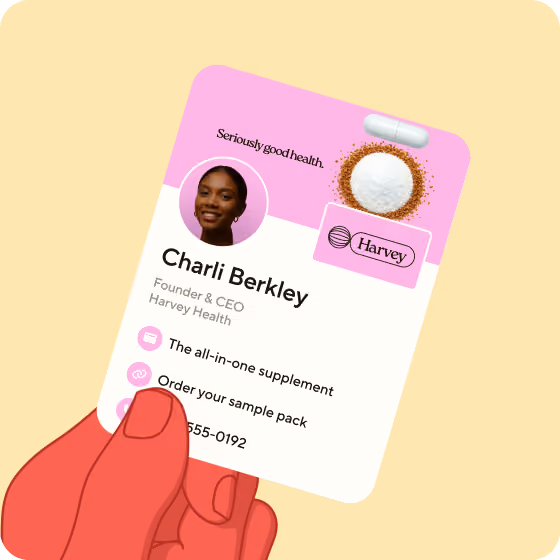
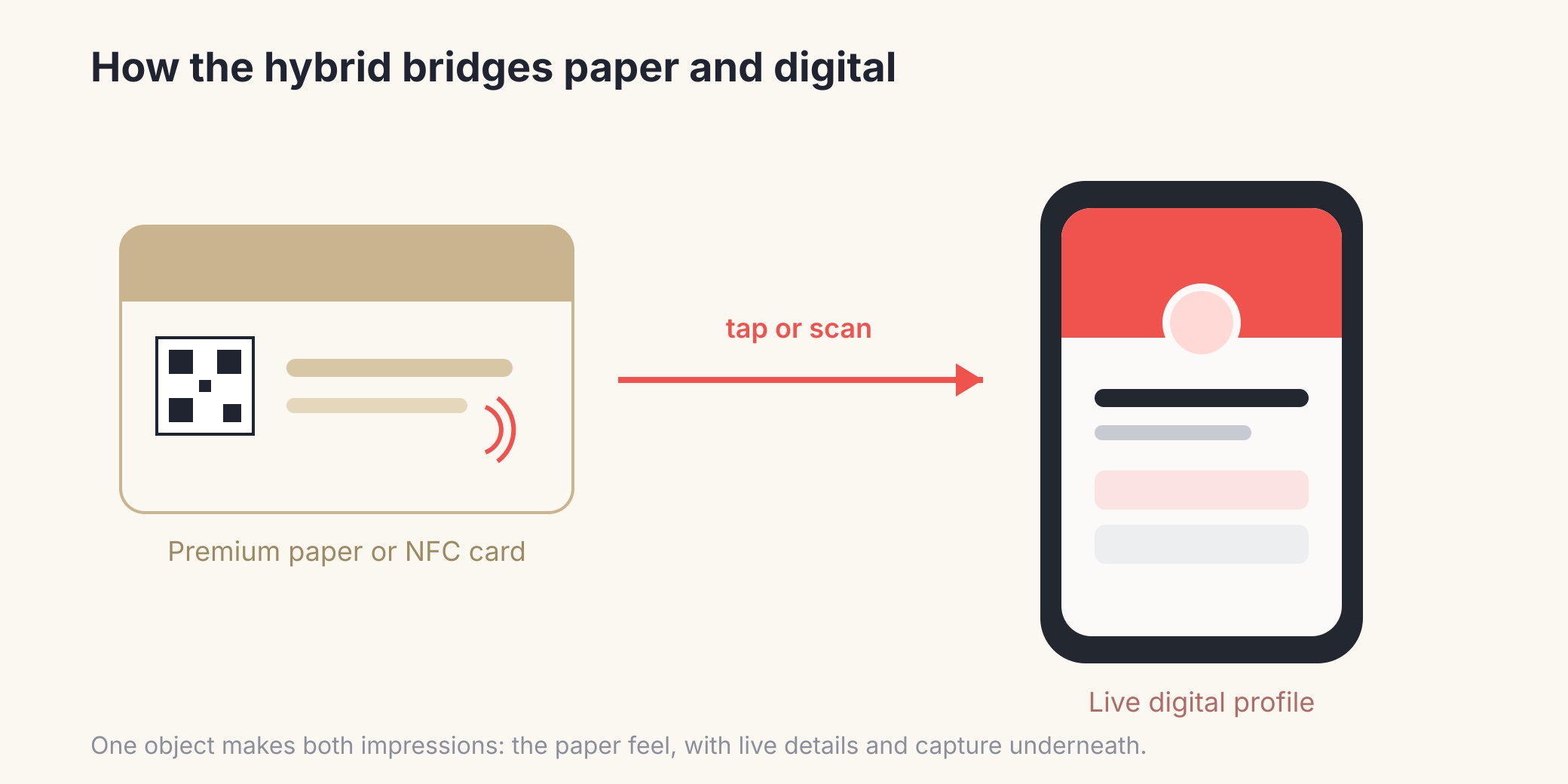
For most people weighing the two, the answer isn't either-or. An NFC business card is a physical card you hand over that shares a live digital profile when tapped against a phone, so it keeps the ritual and the feel while the details stay current and every tap is captured. A lighter version is a QR code printed on premium paper stock: the card in the hand stays letterpress-heavy and traditional, and the QR carries the digital layer, so details stay current and scans are captured even after the paper card is tossed. Some Blinq users do exactly this. Either way, one object makes both impressions.
How do you switch from paper to digital without losing what works?
Switching is a workflow change, and it takes four steps:
- Create a digital card and mirror the details from your paper card. Blinq's free plan is one place to start.
- Decide your hybrid rule: digital by default, paper or NFC for the audiences identified above.
- Wire captured contacts into your CRM with event tags, so the "rubber band problem" doesn't come back.
- Run one event with the new setup before you cancel the next print order.
For teams, the governance is the reason to move: enterprise digital card platforms hold SOC 2 Type II compliance, provision cards automatically so there's no manual admin setup, and give admins centralized control over employee cards, so details stay accurate and on-brand, and a card can be updated or revoked when someone leaves. Printed cards can't be revoked, updated, or audited once handed out.
Create your free digital business card and keep the paper for the rooms that want it. Doors will open.
FAQs
Is it cheaper to use paper or digital business cards?
Digital is cheaper in almost every case. Most digital business cards have a free tier at $0, while an active networker spends roughly $120 to $275 a year on paper at print prices checked in July 2026 ($0.20 to $0.46 per card, plus reprints when details change). Even at very low volume, where a $10 box of 50 can last a year, a free digital plan still costs less and keeps your details current. Paper's price advantage is "cheap," never "cheaper than free."
Do digital business cards make a better first impression than paper?
It depends on the audience. In tech, law, sales, and startup settings, a digital card reads as current and puts your details one tap from saved. In law, finance, and formal international business, a quality paper card still signals respect, and 72% of people judge a business by its card's quality. No independent study crowns either format, so match the format to the room.
Can you use paper and digital business cards together?
Yes, and for many professionals the hybrid is the strongest setup. Common patterns: a digital card as the everyday default with premium paper for formal meetings, an NFC card that keeps the physical handover while sharing a live profile, or a QR code printed on paper stock so details stay current and every scan is captured.
Do digital business cards work if the other person doesn't have an app?
Yes, with the leading tools. When someone scans a QR code, your details open in their browser and save straight to their phone's contacts, with no app to download. With Blinq, for example, the recipient needs nothing installed to save your card. Check the specific tool, since the receiving experience varies.
Are digital business cards secure enough for company-wide use?
The enterprise-grade ones are. Look for SOC 2 Type II compliance, the audit standard IT teams typically require, plus SSO and centralized admin control over employee cards. That's governance paper can't offer, since printed cards can't be revoked, updated, or audited once handed out. Blinq, for example, holds SOC 2 Type II and gives admins central control.
Are paper business cards bad for the environment?
They carry a real waste cost. Printers produce an estimated 27 million business cards a day, and with an estimated 88% thrown away within a week (Adobe, 2016), most of that paper is discarded quickly. A digital or hybrid card cuts the reprint cycle, which is part of why sustainability-minded teams move to it.