

.avif)



Relationship selling is a sales approach that puts long-term trust with the buyer ahead of any single deal. You get to know what someone needs before you pitch, and you stay in touch after the deal closes. None of that is complicated. The part people drop is the follow-through: remembering what mattered to someone, and getting back to them when you said you would. Reps who keep that up win the repeat business and referrals a one-off sale never gets.
Key Takeaways (TL;DR)
- Relationship selling, defined: a sales approach that prioritizes long-term customer relationships and trust over closing a single transaction. Also called relationship-based selling or relationship sales.
- Trust is the deciding factor: in high-value deals, buyers choose the person as much as the product, so trust does more work than any pitch.
- Retention rewards patience: keeping a customer costs far less than winning a new one, which is what makes the slower first deal worth it.
- The process has five stages: connect, understand, add value, close, and nurture.
- The techniques are learnable: active listening, asking open questions, finding common ground, honesty, and on-time follow-up beat any script.
- Follow-up carries the relationship: most relationships stall in the gap between the first meeting and the follow-up, so capture the contact and the context while you're still in the room.

What is relationship selling?
Relationship selling is a sales technique that treats the relationship with the customer as worth more than any single sale. Rather than pushing for a quick close, you build trust, work out what the buyer needs, and keep showing up after the deal's done. It earns its keep on high-consideration purchases, the ones where people are choosing who to work with as much as what to buy.
You'll hear it called relationship-based selling or relationship sales, but it's the same thing under each label: you build a relationship that's worth something to both sides over time. The trade is simple. You slow the deal down so the next few move faster, and you treat each conversation as something you're putting into the account, not taking out.
In practice the long view shows up in small ways. A relationship seller asks more than they pitch in that first meeting. They follow up when they said they would. And they remember the offhand thing the buyer mentioned weeks ago, which is usually what makes the next call land.
Why relationship selling works (and when it doesn't)
Two things make it pay off: buyers lead with trust, and keeping a customer costs a fraction of winning a new one. LinkedIn's 2018 State of Sales report found 51% of decision makers rank trust as the No. 1 attribute they want in a salesperson. That tracks with just about every buying decision I've watched up close.
The economics are just as blunt. Harvard Business Review reports it costs 5 to 25 times more to win a new customer than to keep one, and that lifting retention by 5% raises profits by anywhere from 25% to 95%, a figure it credits to Bain's Frederick Reichheld. The repeat orders and referrals more than pay back the slower start.
Buyers are also pulling away from reps who rush them. Gartner's 2026 survey found 67% of business-to-business (B2B) buyers now prefer to buy without a rep involved at all, up from 61% a year earlier. There's less room in the room, so the reps who earn trust are the ones who still get invited in. Dale Carnegie put it well back in 1936: "You can make more friends in two months by becoming interested in other people than you can in two years by trying to get other people interested in you."
It's not always the right approach, and I'd be lying if I said it was. For a cheap, one-time purchase someone decides on in minutes, the nurturing costs more than the account will ever return. Close those fast and save the relationship work for the deals that pay it back.
The stages of the relationship selling process
Relationship selling usually moves through five stages: connect, understand, add value, close, and nurture. Each one sets up the next. Skip ahead and the deal tends to stall right at the close, because the trust a close leans on was never built.
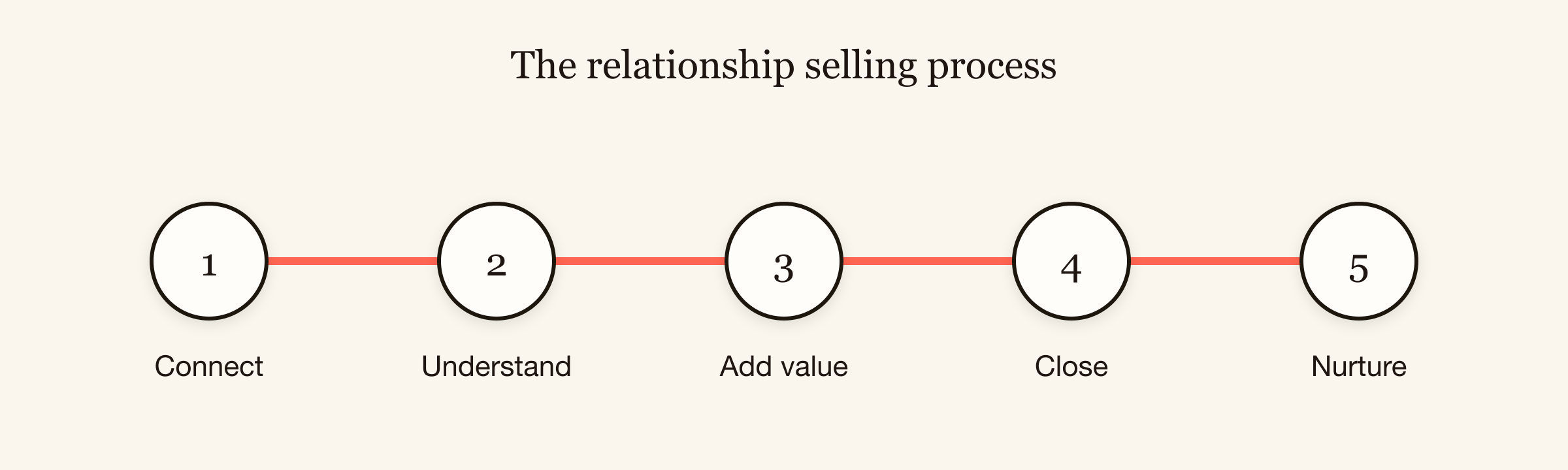
- Connect. Meet the person, and capture the moment while it's fresh. It could be a booth at a trade show or a first sales call. Get their details down with a quick note on what you discussed, before either one fades on you.
- Understand. Learn how the buyer sees the world before you pitch a thing. Ask open questions about their goals and constraints, and listen for the problems they say out loud and the ones they only hint at.
- Add value. Help before you ask for anything back. A relevant intro, or a heads-up about something moving in their market. That's what gives someone a reason to take your next call.
- Close. Make your case once the fit is real, and be straight about where you come up short. A deal built on trust holds together through procurement and a security review, even when someone you never met weighs in at the eleventh hour.
- Nurture. Keep turning up after the signature. Ask how it's going, flag problems before they land as complaints, and stay close enough that a renewal or a referral feels like the obvious next move.
Core relationship selling techniques
Relationship selling techniques are learnable, every one of them, and none need charisma. The seven below run from the first hello to the follow-up a few weeks later. The difference between an average rep and a good one comes down to whether they bother to do them.
- Listen more than you talk. Let the buyer finish, play back what you heard, and note the details you'll want later. Walk into the second meeting able to reference something specific from the first, and you're already ahead of everyone who forgot.
- Ask open questions. "How does your team handle leads after an event?" opens a door. "Do you have a budget for this?" closes one. The open version surfaces the real buying process, and the problem sitting behind the one they raised first.
- Find common ground. A mutual contact, or a shared gripe about the market. It gives the relationship somewhere human to sit, and a lot of that turns up in small talk, so listen for it.
- Lead with insight. Bring the buyer something they didn't already know about their own problem. Do that and you're the person worth another meeting, rather than another quote to weigh up.
- Be honest, especially about fit. If you're not right for them, say so and point them somewhere better. You'll lose that deal and keep a relationship that usually outlasts the one you lost.
- Do the small things well. Send the recap the day you promised it. Answer the procurement question before it's asked. String enough of those together and the buyer comes to expect that standard from you, which beats any one grand gesture.
- Follow up on time, with context. This is the one most reps let slip, and it's where relationships go cold. Reach out while the conversation's still warm, name what you talked about, and put a real next step on the table. It's why digital business cards for sales teams build the capture and the follow-up into one move.
Relationship selling examples
Relationship selling shows up at three moments: the first meeting, the expansion a year in, and the deal you lose without losing the person.
The trade show follow-up that lands. An account executive (AE) meets 40 people at a conference. One mentions a platform migration coming in Q3. She adds the contact and a one-line note on the spot, then emails two days later about the migration with a case study that fits. She gets the call. The other 39 "great to meet you" emails go nowhere, because none of them remembered a thing.
The expansion built on trust. A rep keeps in touch every quarter after a small first deal, shares a benchmark or two, and points out a billing error the customer hadn't caught. Eighteen months on, when that company consolidates vendors, the rep's product picks up two competitors' contracts with no formal request for proposal (RFP). The buying committee already knew who they trusted.
The deal you lose well. A rep tells a prospect, out loud, that a competitor is the better fit for their edge case. A year later that prospect lands at a new company with a budget, calls the honest rep first, then sends two more people their way. The honesty is what stuck.
Relationship selling vs transactional selling
People often set these two against each other, but they're built for different jobs. Relationship selling plays the long game across a whole account. Transactional selling optimizes the single sale and moves on. A transactional rep competes on speed and price, then goes to find the next lead; a relationship rep earns trust, holds the account, and grows it. Most teams do both and pick based on the size and complexity of the deal in front of them.

People use consultative and relationship selling interchangeably, so it's worth separating them. A consultative seller works like an advisor on a single deal, diagnosing the problem before recommending a fix. Relationship selling is the wider posture you hold across every deal you'll ever do with that buyer. In my experience the best reps are running both at once and don't think of them as two separate things.
Where tools fit in relationship selling
Every technique here runs on one thing: knowing who you met, what you talked about, and when to come back. That's also the exact spot where relationships fall apart, in the gap between meeting someone and following up. I've lost count of the good conversations I've watched die in that gap.
Buyers describe it the same way it comes up on our sales calls. As one marketer who runs events at a B2B software company put it: "...sometimes it may rely on memory or sometimes a conversation may fall through the cracks. It's always best to capture that info as soon as possible."
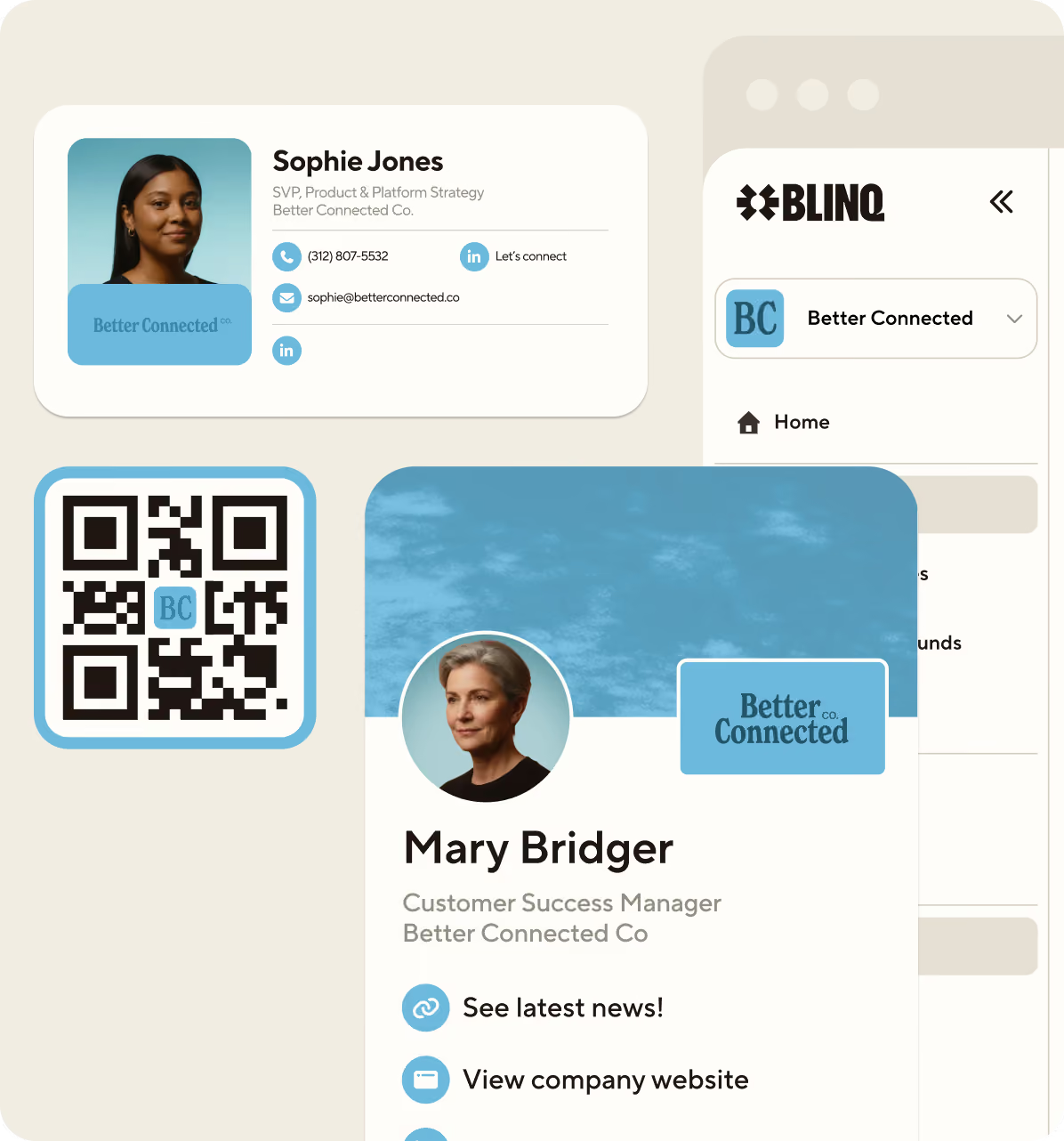
That's the work a digital business card does. Blinq captures the person and the context the second you share your card, then syncs both to your customer relationship management (CRM) system: who they are, where you met, and the note that makes your follow-up specific instead of forgettable. That's what we call contacts with context.
Nurture leans on the same discipline, just stretched over years. Staying useful to a customer means having a system for who to reach and when, which is why teams lean on the right tools to stay in touch instead of their memory. The relationship starts the moment you meet someone, and the follow-up is what keeps it going.
Never let a good first meeting go cold. Create your free Blinq card and capture the moment you meet someone.
Frequently asked questions
What is relationship selling in simple terms?
You build the relationship first and let the sale follow. You listen, help, and stay in touch, then make your case once the fit is obvious. You give up a fast first deal in exchange for repeat business and referrals down the line.
Is relationship selling still effective in B2B?
Yes. Buyers still put trust at the top of what they want from a salesperson, and it's far cheaper to keep a customer than to win a new one. As more buying happens with no rep in the room, the ones who do get in are the ones who earned it. Big, complex deals still turn on trust between people.
What skills does relationship selling require?
Active listening, sharp questions, empathy, honesty, and follow-up you deliver. None of it takes natural charisma. What sets the best apart is unglamorous: they write down who they met and what was said, then follow up on time with that context.
Is relationship selling manipulative?
It can be, if you fake friendship to get a signature. It's honest when the interest is real and you're upfront about being a seller. My test: would you give the same advice with no commission on the line? Be open about your angle, skip the warmth you don't feel, and walk away from bad-fit deals. Reddit's r/sales is full of people calling out the fake version, and they're right to.
What is relationship selling in marketing?
The marketing parallel is relationship marketing: earning loyalty through retention, personalization, and steady engagement rather than one-off campaigns. Relationship selling is the one-to-one version of the same bet. A salesperson builds trust with one buyer; relationship marketing builds it with a whole audience. Both back lifetime value over a single conversion.